

Air Cooled vs Water Cooled Chiller in Bangladesh — Which Should Your Factory Buy?
For most Bangladeshi factories below roughly 100 TR, an air cooled chiller is the right buy. Above roughly 150 TR on two or three shifts, a water cooled chiller with a cooling tower usually earns back its larger scope through lower power per TR — provided there is reliable water and someone who actually controls the water chemistry. This guide gives the working, so you can check it against your own plant.
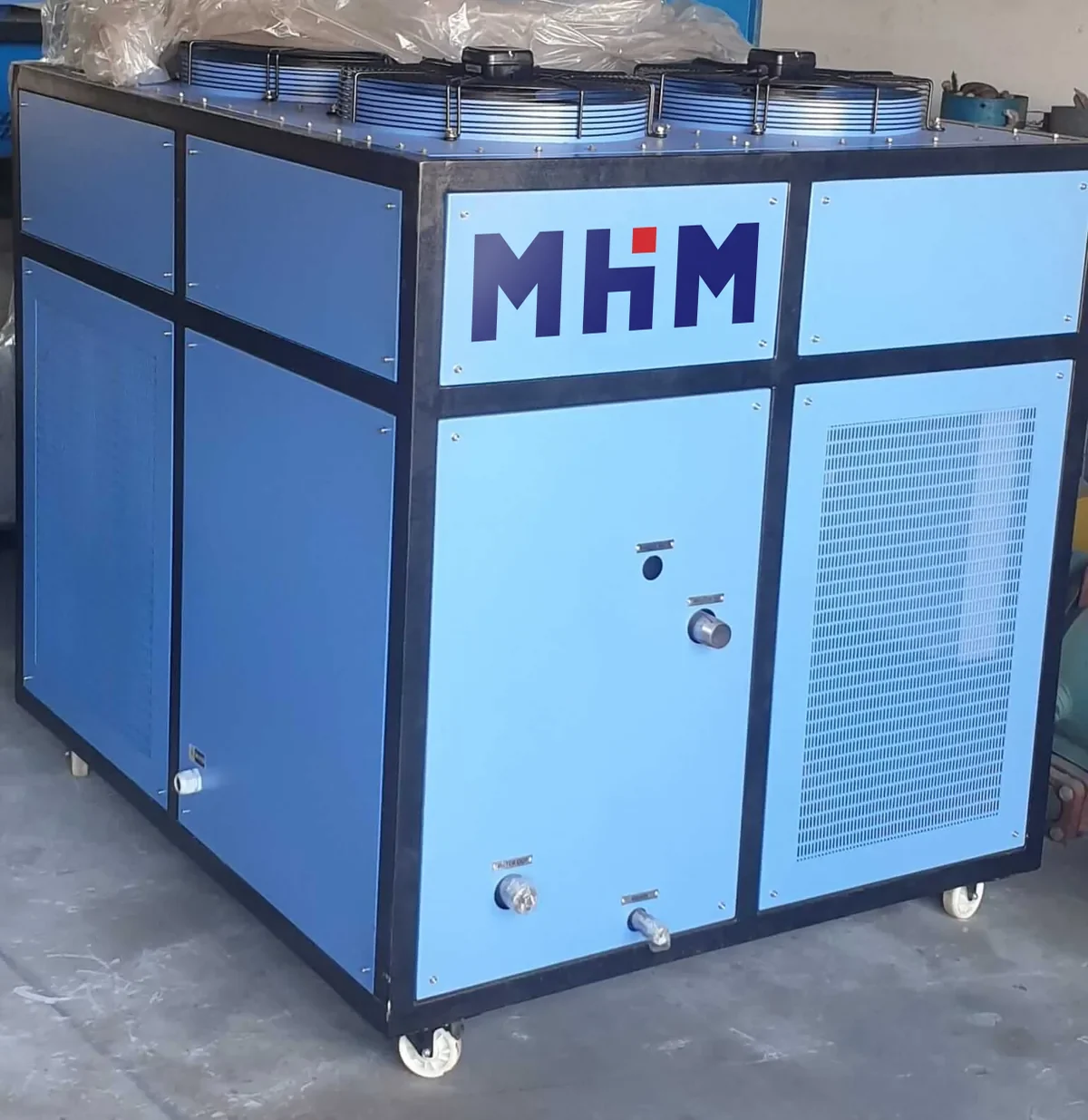
- Decide on load, water, running hours, space and maintenance
- Water cooled: lower kW per TR, plus tower, pumps and treatment
- Air cooled: no water, no plant room, quicker restart
- Between 50 and 150 TR, run the payback sum
Updated 21 October 2026 · MHM Machineries BD Ltd, Mirpur, Dhaka
At a glance
- Under about 50 TR
- Air cooled, almost always
- 50 to 150 TR
- A calculation: running hours, water, space and payback decide
- Over about 150 TR, two or three shifts
- Water cooled, if water and water treatment are reliable
- No reliable water
- Air cooled, at any size
- The real difference
- Where the condenser rejects heat: into air, or into water sent to a cooling tower
- Water cooled extra scope
- Cooling tower, condenser pump, condenser piping, plant room and water treatment
- Size before you choose
- Measure flow and temperature drop; kW = m³/h × ΔT × 1.163
Already decided?
Go straight to the page for the machine you need.
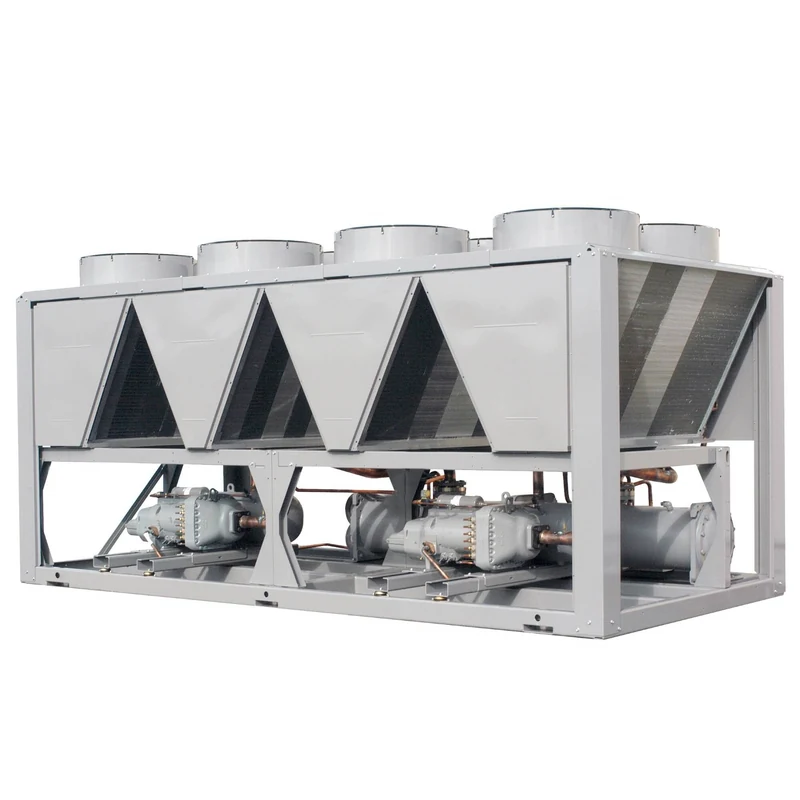
Air cooled chiller
Rejects heat straight to outdoor air through finned coils and fans. No tower, no condenser pump, no water chemistry.
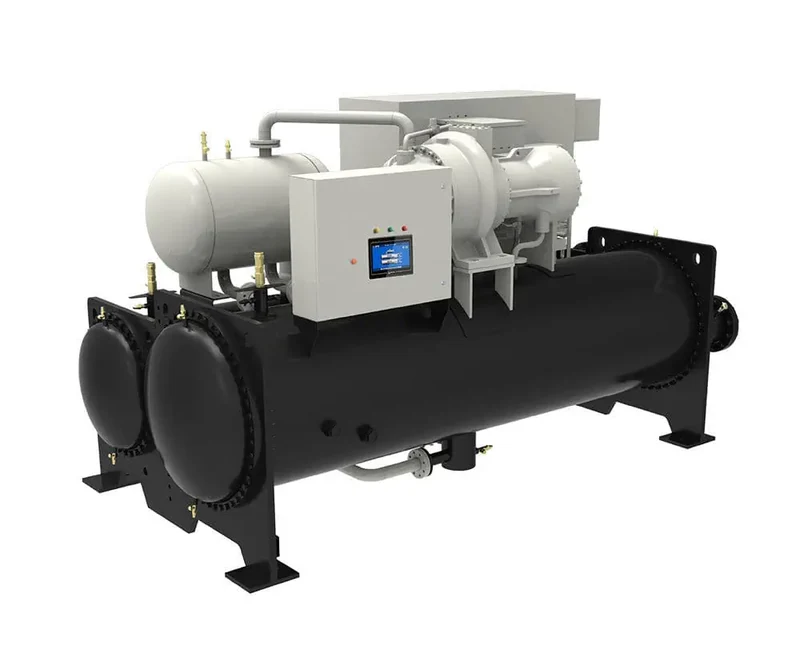
Water cooled chiller
Rejects heat into condenser water and a cooling tower. Lower power per TR on a continuous load, larger scope.
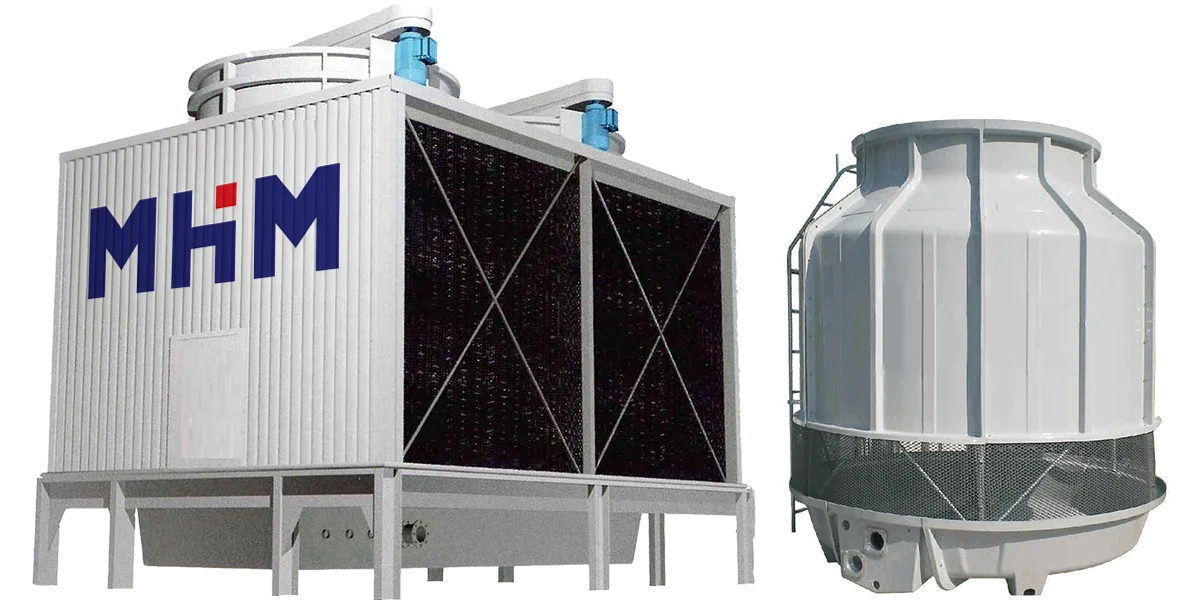
Chiller and cooling tower package
The whole water cooled loop from one supplier, priced as one scope with the lines shown separately.
When an air cooled chiller is the right answer
Suppliers earn more on the bigger scope, so start here. Air cooled is the correct engineering answer — not a cheap compromise — whenever any of these is true.
- Load under about 50 TR. A tower, pumps and a dosing programme rarely pay for themselves at this size.
- No reliable, permitted water. Unreliable supply, hard or high-iron ground water, or no permission to draw it makes a cooling tower a liability.
- Rooftop or rented space only. No plant room, no tower position, or a structure that cannot carry the tower’s operating weight.
- Intermittent or seasonal duty. Below about eight running hours a day the energy saving never pays back, and an idle basin grows biology.
- No one to run the water. Weekly chemistry and blowdown control need a named person.
- Frequent outages where the process must restart quickly with the fewest interlocks.
Between 50 and 150 TR
In this band on two shifts it is genuinely a calculation. Work through the decision steps and the payback sum below with your own load, running hours and electricity tariff.
Both machines run the same vapour-compression cycle — if that is new, read how a chiller works first. The only real difference is where the condenser dumps its heat: into moving air, or into water sent to a cooling tower. Every row in the comparison below follows from that.
Air cooled vs water cooled chiller: side by side
Swipe the table sideways to see every column.
| Factor | Air cooled chiller | Water cooled chiller + cooling tower |
|---|---|---|
| Installed scope | One package, one power feed, minimal civil work | Machine plus cooling tower, condenser pump, condenser piping, plant room civil and electrical work, and water treatment |
| Space | Rooftop or open yard, no plant room; needs free air all round and an unobstructed discharge | Plant room with tube-pull clearance, plus a tower location and a structure checked for the tower’s operating weight |
| Heat sink | Outdoor dry-bulb temperature | Outdoor wet-bulb temperature, through the tower |
| Energy per TR | Higher — it condenses against hot air | Lower — compare plant kW per TR, including condenser pump and tower fan |
| Water use | None | About 1 m³/h of make-up per 100 TR at three cycles of concentration |
| Water cost exposure | Nil | Utility tariff and sewerage charge on blowdown, or ground water with its own permission, pumping and pre-treatment |
| Maintenance | Coil washing (Dhaka dust), fan bearings, refrigerant charge; no water team | Weekly water chemistry and dosing, blowdown control, condenser tube cleaning, tower infill, drift eliminators, sprinkler and fan drive |
| Hard season in Bangladesh | April and May, when dry-bulb peaks | June to September, when wet-bulb peaks |
| Noise outdoors | Condenser fans sit outside — what neighbours hear | Compressor stays in the plant room; only the tower fan is outside |
| Load-shedding | One motor group, restarts quickly, no interlock sequence; more generator kW per TR | Less generator kW per TR, but condenser pump and tower fan must start before the compressor loads |
Why water cooled wins on paper: condensing temperature
A compressor’s work is set by the lift between evaporating and condensing pressure. Both types evaporate at the same place — around 2–4 °C for 7 °C chilled water — and differ entirely on the condensing side.
| Condensing side | Air cooled | Water cooled |
|---|---|---|
| Heat sink temperature | Dry-bulb, about 35–36 °C | Wet-bulb, about 28–29 °C |
| Approach to that sink | Coil approach roughly 12–15 °C | Tower approach about 4 °C, condenser range 5 °C, condenser approach 2–3 °C |
| Resulting condensing temperature | About 48–51 °C | About 40–41 °C |
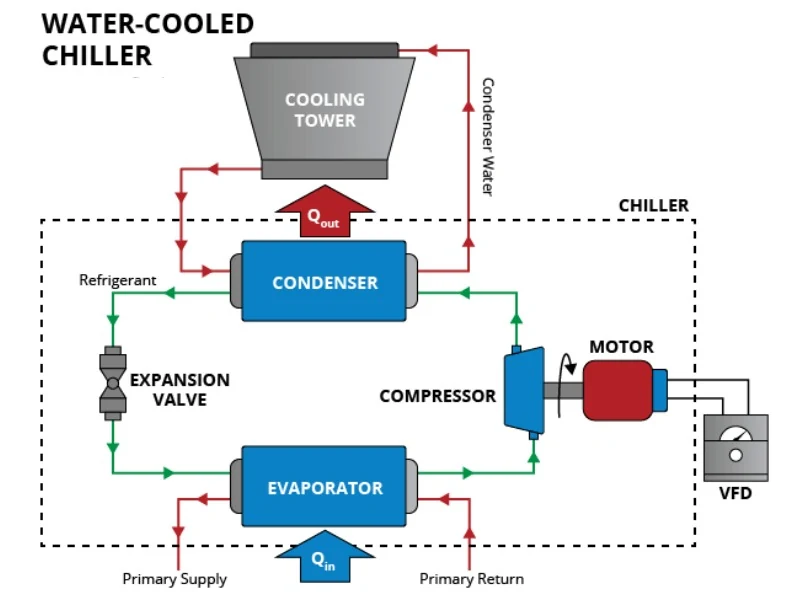
That is roughly an 8–11 °C lower condensing temperature for the water cooled machine, and every degree of condensing temperature is compressor work. Two honest qualifications:
- Compare plant kW per TR — compressor plus condenser pump plus tower fan — not the compressor alone, because the pump and fan give part of the advantage back.
- Leave the chilled-water pump out of both sides; both systems need one.
- Ask every supplier for kW per TR at your design condition, in writing. MHM’s own MCH data sheet gives one power column for the whole range without a rating condition, so it is not a basis for comparing the two types.
What the water actually costs you
A worked example from MHM’s own data sheets: one MCH-100 water cooled machine.
An MCH-100 is 351.7 kW of cooling with an 80 kW compressor, so the tower has to reject about 431.7 kW. At a 5 °C condenser range that heat needs about 74 m³/h of condenser water — close to the 0.7 m³/h per chiller TR that MHM’s tower table circulates.
- Evaporation: as a rule of thumb about 1% of the circulating flow for every 5.5 °C of range, so about 0.67 m³/h. Unavoidable — it is how a tower works.
- Blowdown: evaporation divided by (cycles of concentration minus one). At three cycles, another 0.34 m³/h.
- Drift: very small with intact drift eliminators; a visible plume of droplets means they are damaged.
Make-up is therefore about 1 m³/h per 100 TR. Ten hours a day, twenty-six days a month, is roughly 260 m³ a month. Multiply by your water tariff, add any sewerage charge on blowdown, and check that your ETP can take it.
The lever most plants never pull: raising cycles of concentration from three to five halves the blowdown and cuts make-up by about one sixth. It needs a real treatment programme — see cooling tower water chemicals — because higher cycles concentrate hardness, silica and chlorides.
Selecting the tower for that machine
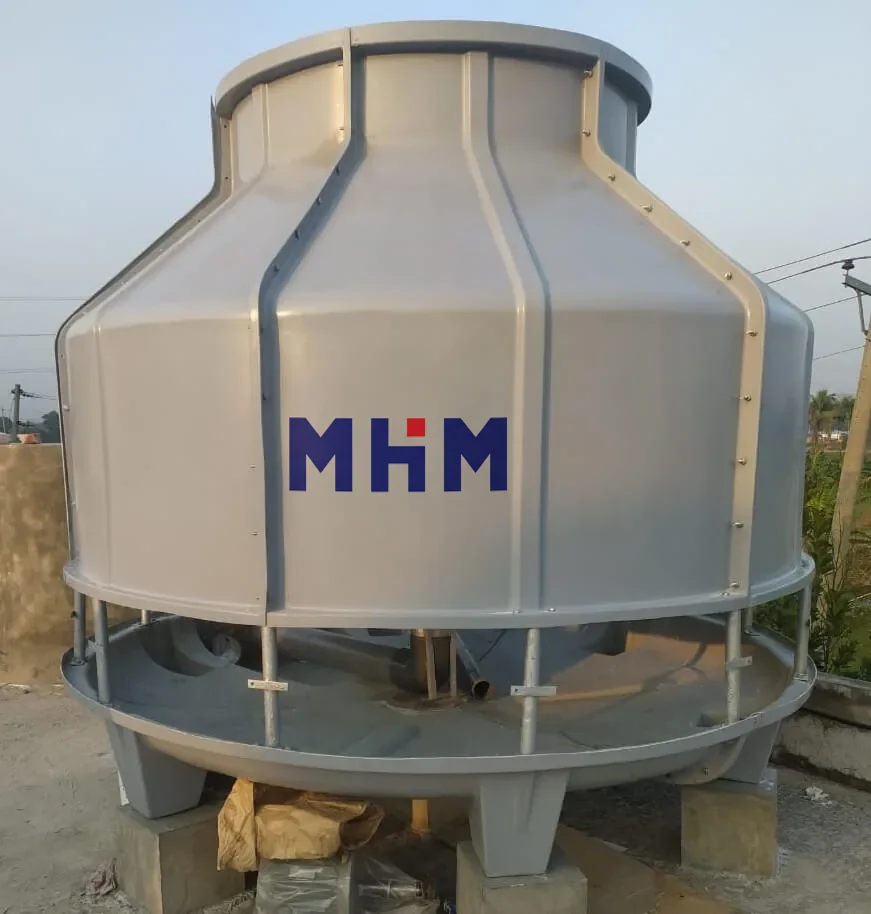
Work in kW of heat rejection, not chiller TR. A tower TR is a nominal rating that already includes the compressor heat: at about 0.7 m³/h per TR and a 5 °C range one tower TR carries roughly 4.1 kW. 431.7 ÷ 4.1 ≈ 105 tower TR, so the 125 TR row of MHM’s bottle-type table is the selection. Never multiply the chiller TR by 1.25 and then read a tower table as if a tower TR were a chiller TR — that counts the compressor heat twice and oversizes the tower. Full method: cooling tower sizing.
Size the load before you choose the type
Neither choice matters if the TR figure is a guess. Measure flow and temperature difference on the process side.
Cooling load (kW) = flow (m³/h) × ΔT (°C) × 1.163, and TR = kW ÷ 3.517.
The same in litres per second: kW = flow (l/s) × 4.19 × ΔT. In US units: TR = US gpm × ΔT (°F) ÷ 24.
Worked example
60 m³/h returning at 12 °C and supplied at 7 °C is 60 × 5 × 1.163 = 349 kW = 99 TR. Cross-check: 264 US gpm × 9 °F ÷ 24 = 99 TR. Add 10–15% for fouling and pipe heat gain and you need about 110–115 TR — on MHM’s range an MCH-120, or two MCH-60 modules so one carries the plant during service and part load runs better.
Bangladesh-specific realities
The two worst months are different for each type
Humidity does not hurt an air cooled chiller; heat does. Its bad season is April and May, when dry-bulb peaks and head pressure climbs. A cooling tower is the mirror image: it tracks wet-bulb, so its bad season is the monsoon. Selecting a tower on an imported catalogue’s rating wet-bulb is the classic error — at Bangladesh’s design wet-bulb it delivers warmer water than the datasheet promises, and the chiller derates with it.
Dust
A coil blanketed with brick-kiln and construction dust raises condensing temperature exactly as scale does. Budget regular coil washing, and specify coated coils at coastal sites or next to an ETP or a dye house.
Load-shedding and generator behaviour
A water cooled plant draws fewer kW per TR, so it needs less generator capacity per TR — a saving that is routinely overlooked. The trade-off is complexity: the condenser pump and tower fan must be interlocked to start before the compressor loads, or the machine trips on high head pressure at every restart. If your site loses power several times a day, ask the supplier to demonstrate the restart sequence.
Noise and neighbours
Bangladesh’s Noise Pollution (Control) Rules set day and night limits by zone, and residential zones are far tighter than industrial ones. An air cooled chiller puts its noisiest part outdoors, so a rooftop unit near a residential boundary needs checking early. A water cooled plant keeps the compressor indoors, leaving only the tower fan outside.
Decision steps: air cooled or water cooled?
Answer in order and stop at the first answer that decides it.
- Is your measured load below about 50 TR? Yes: air cooled. No: continue.
- Is there reliable, permitted water of acceptable hardness and iron? No: air cooled. Yes: continue.
- Does the plant run more than about eight hours a day, most days of the year? No: air cooled — the saving will not pay back. Yes: continue.
- Is there a plant room, a tower position with clear air, and a structure checked for the tower’s weight? No: air cooled. Yes: continue.
- Is someone responsible for weekly chemistry, dosing and blowdown? No: air cooled — an untreated tower loses the advantage. Yes: continue.
- Is the load above about 150 TR? Yes: water cooled is very likely right. No: continue.
- Run the payback calculation below. Under about three years: water cooled. Over about five: air cooled. In between, let noise, space and maintenance capability decide.
- Confirm the selection at your own site conditions. Ask for capacity and kW per TR at your design ambient or wet-bulb, never only at the catalogue rating point.
The ten-minute payback calculation
Use your own quotations and your own electricity bill.
Annual energy saving (kWh) = (air cooled kW/TR − water cooled plant kW/TR) × TR × equivalent full-load hours.
Equivalent full-load hours are running hours multiplied by the average load factor. Ten hours a day, twenty-six days a month, at a 0.7 load factor is about 2,180 hours a year.
Then subtract what the water cooled plant costs to run and the air cooled plant does not: make-up water (about 3,150 m³ a year per 100 TR at those hours), the dosing programme and the extra maintenance labour. Divide the extra installed cost by what is left. That number, not a brochure, is the decision.
An example with stated inputs
Suppose two quotations for 100 TR state 1.20 kW/TR for the air cooled machine and 0.85 plant kW/TR for the water cooled plant, both at your design condition. The difference is 0.35 kW/TR, or 35 kW. Over 2,180 equivalent full-load hours that is about 76,000 kWh a year. Multiply by the per-kWh rate on your own bill. These two kW/TR figures are an example only — use the figures from your own quotations.
Five mistakes Bangladeshi factories make when choosing
- Comparing machine price instead of installed system cost. A water cooled quotation without the tower, pumps, piping, civil work and treatment cannot be compared with an air cooled quotation that includes everything. Ask for both options on one scope sheet.
- Selecting on the catalogue rating point. Imported data is often stated at a condenser-water or ambient condition milder than a Bangladeshi summer or monsoon. Ask for the performance at your own design condition.
- Oversizing for safety. An oversized chiller short-cycles and runs badly at part load. Measure the load, add a sensible margin, and use two modules or a variable-speed drive for turndown.
- Buying the tower and skipping the water treatment budget. Scale and biofilm insulate the condenser tubes and raise the condensing temperature until the water cooled machine behaves like an air cooled one. Watch the condenser approach against its commissioning value, and clean the tubes when it climbs. Standing basin water is also a Legionella risk.
- Boxing in a rooftop air cooled unit. Parapet walls, neighbouring units or a shed roof push hot discharge air back into the coil, and the result is high-pressure trips every afternoon in April. Keep the maker’s clearances and a clear discharge path upward.
Background reading: how often a cooling tower should be cleaned, cooling tower infill and which compressor type suits your duty.
সংক্ষেপে: কোনটি আপনার কারখানার জন্য
লোড যদি প্রায় ৫০ TR-এর নিচে হয়, অথবা পানির নিশ্চিত সরবরাহ না থাকে, অথবা মেশিন দিনে ৮ ঘণ্টার কম চলে — এর যেকোনো একটি সত্যি হলে air cooled chiller-ই সঠিক সিদ্ধান্ত। এতে cooling tower, condenser pump, plant room বা water treatment-এর ঝামেলা নেই।
লোড ১৫০ TR-এর বেশি এবং কারখানা দুই-তিন শিফট চললে water cooled chiller প্রতি TR-এ কম বিদ্যুৎ নেয়। অতিরিক্ত খরচ কত দিনে উঠে আসবে তা নিজের quotation আর বিদ্যুৎ বিল দিয়ে হিসাব করুন — প্রায় ৩ বছরের কম হলে water cooled, ৫ বছরের বেশি হলে air cooled। শর্ত একটাই: cooling tower-এর পানির chemistry নিয়মিত দেখভাল করতে হবে।
প্রতি ১০০ TR-এ ঘণ্টায় প্রায় ১ m³ makeup water লাগে। Tower বাছাই করুন kW-এ: MCH-১০০-এর ৩৫১.৭ kW cooling আর ৮০ kW compressor মিলিয়ে ৪৩১.৭ kW, ভাগ ৪.১ = প্রায় ১০৫ tower TR, তাই ১২৫ TR tower। ফোন +880 1767-004433।
Frequently asked questions
Which is better, an air cooled or a water cooled chiller?
Neither is better everywhere. Water cooled machines use less electricity per ton because they reject heat to wet-bulb rather than dry-bulb temperature, so they suit large continuous loads with reliable water. Air cooled machines win on installed scope, space, water use and simplicity, which is why most Bangladeshi plants under about 100 TR choose them.
Is a water cooled chiller more efficient than an air cooled chiller?
On energy, yes: it condenses roughly 8 to 11 degrees Celsius cooler at Dhaka design conditions, and every degree of condensing temperature is compressor work. Compare plant kW per TR including the condenser pump and tower fan, at your own design condition, using the figures stated on each quotation.
How much water does a cooling tower use per day?
About one cubic metre of make-up per hour for every 100 TR at three cycles of concentration, counting evaporation, drift and blowdown together. A 100 TR plant running ten hours a day therefore uses roughly 10,000 litres a day. Higher cycles of concentration reduce the blowdown share.
Do air cooled chillers work well in high humidity?
Yes. Air cooled condensers reject heat to dry-bulb temperature, so humidity barely affects them; high air temperature is what hurts them, making April and May the hard months in Bangladesh. Cooling towers are the opposite, losing capacity in the humid monsoon when wet-bulb temperature peaks.
How many TR of chiller do I need for my factory?
Measure it rather than guess. Cooling capacity in kW equals chilled water flow in cubic metres per hour times the temperature difference in degrees Celsius times 1.163; divide by 3.517 for TR. So 60 cubic metres per hour across 5 degrees is 99 TR. Add ten to fifteen percent margin.
What size cooling tower does a 100 TR water cooled chiller need?
Work in kW of heat rejection. An MHM MCH-100 is 351.7 kW of cooling plus an 80 kW compressor, so 431.7 kW. One tower TR carries roughly 4.1 kW at about 0.7 cubic metres per hour per TR and a 5 degree range, so the duty is about 105 tower TR and the 125 TR row is selected. Do not apply a 1.25 factor to the chiller TR and then read the tower table again.
Can a water cooled chiller run on a generator during load shedding?
Yes, and it usually needs less generator capacity per TR than an air cooled chiller because plant kW per TR is lower. The catch is restart sequencing: the condenser water pump and tower fan must run before the compressor loads, or the machine trips on high head pressure.
What is the cost difference between air cooled and water cooled chillers?
Compare installed system cost, not machine cost. A water cooled scope adds the cooling tower, condenser pumps, condenser piping, plant room civil and electrical work, and a water treatment programme. Ask any supplier to quote both options on one scope sheet so the comparison is like for like, then run the payback sum on this page.
Related pages on this site
Get a written quotation
Send your flow and temperature drop, the running hours and the site, and ask MHM Machineries BD Ltd to price both options against the same duty.
- Capacity stated against your measured load
- kW per TR stated with its rating condition
- Equipment, accessories and installation as separate lines
- Delivery and lead time confirmed in writing
- MHM Machineries BD Limited
846, East Shewrapara, Mirpur, Dhaka-1216, Bangladesh
Open in Google Maps - +880 1767-004433 · +880 1300-806868
WhatsApp +880 1767-004433 - sales@mhmmachineries.com
Tell us the duty
Fill this in and send it straight to our sales desk on WhatsApp or by e-mail. Nothing is stored on this page.