

Cooling Tower Supplier in Bangladesh — Counter Flow and Cross Flow
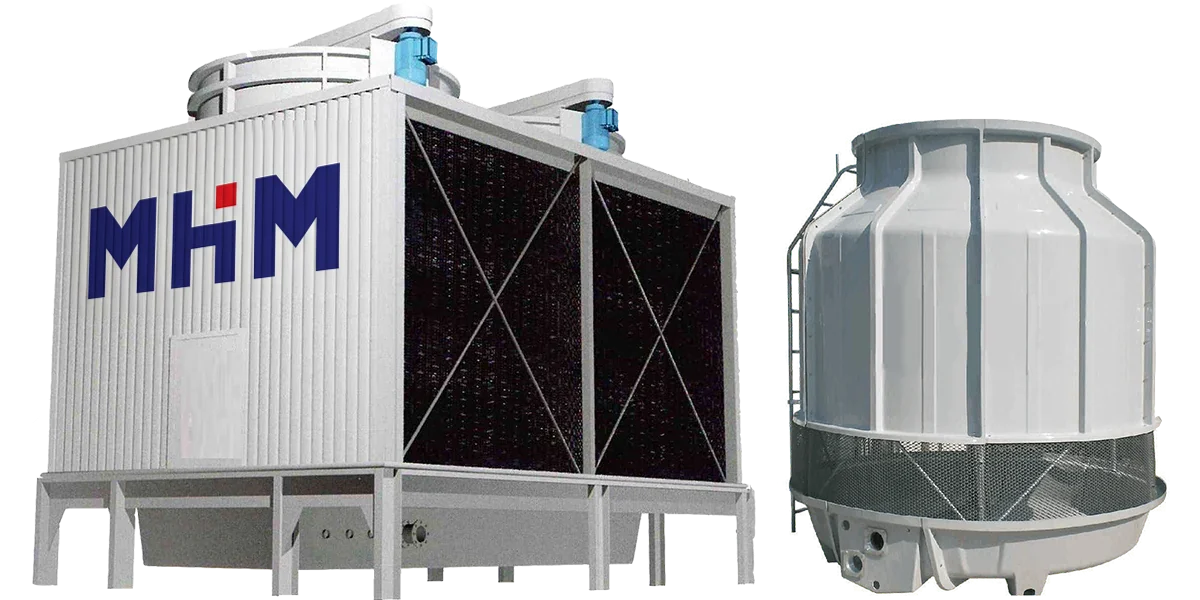
A cooling tower rejects process and condenser heat to the atmosphere by evaporating a small part of the circulating water, and returns cooled water to the plant. MHM Machineries BD Ltd supplies counter flow and cross flow cooling towers across Bangladesh — the published FRP bottle-type range runs 10 TR to 500 TR — with infill, fans, motors, sprinklers, pumps, installation and service from Mirpur, Dhaka.
- Published FRP bottle-type range: 10 TR to 500 TR
- Counter flow bottle and square, cross flow rectangular and splash
- Infill, sprinkler, nozzle, fan, motor, louver and pipe in stock sizes
- Installation, cleaning, fill replacement and service contracts
Updated 18 September 2026 · MHM Machineries BD Ltd, Mirpur, Dhaka
At a glance
- Capacity range
- The published bottle-type table runs 10 TR to 500 TR; the data sheet header states the range as 10 TR to 600 TR, so confirm anything above 500 TR on the quotation
- Types supplied
- Counter flow bottle type, counter flow square type, cross flow rectangular type, cross flow splash type
- Condenser water flow
- About 0.7 m³/h per tower TR — 7 m³/h at 10 TR, 350 m³/h at 500 TR
- Fan motors
- 0.18 kW at 10 TR rising to 11 kW at 500 TR
- Origin
- Bottle-type range imported from China, Malaysia and Thailand; ready stock held on common sizes
- Spares
- Infill, sprinkler head, spray nozzle, fan, motor, distribution pipe, air inlet louver, water treatment chemicals
- Coverage
- Dhaka and the industrial belts of Gazipur, Narayanganj, Savar, Ashulia, Tongi and Chattogram
The four tower types, and how to choose between them
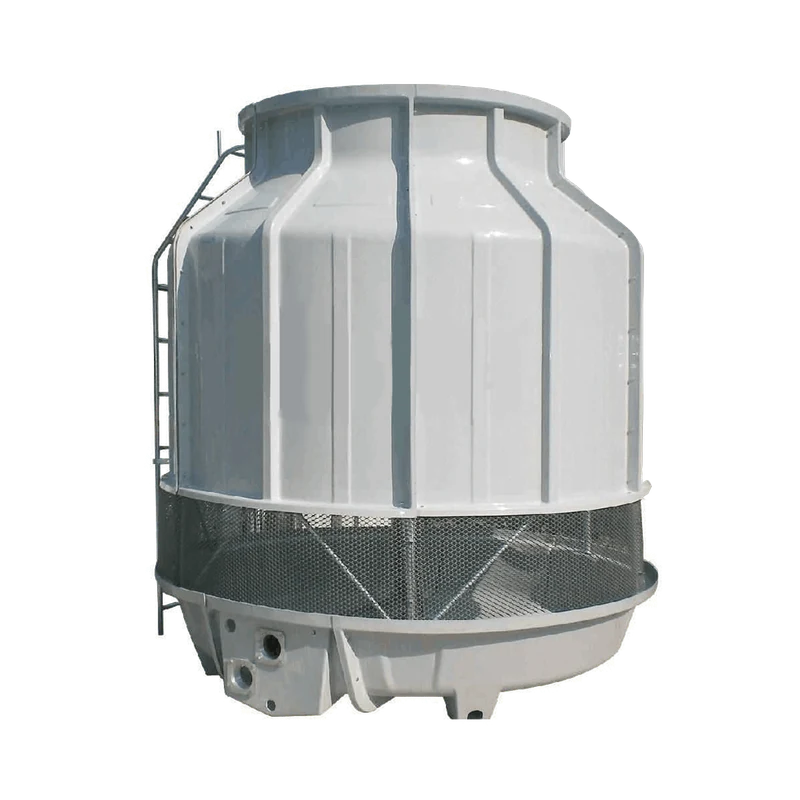
Counter flow bottle type (FRP)
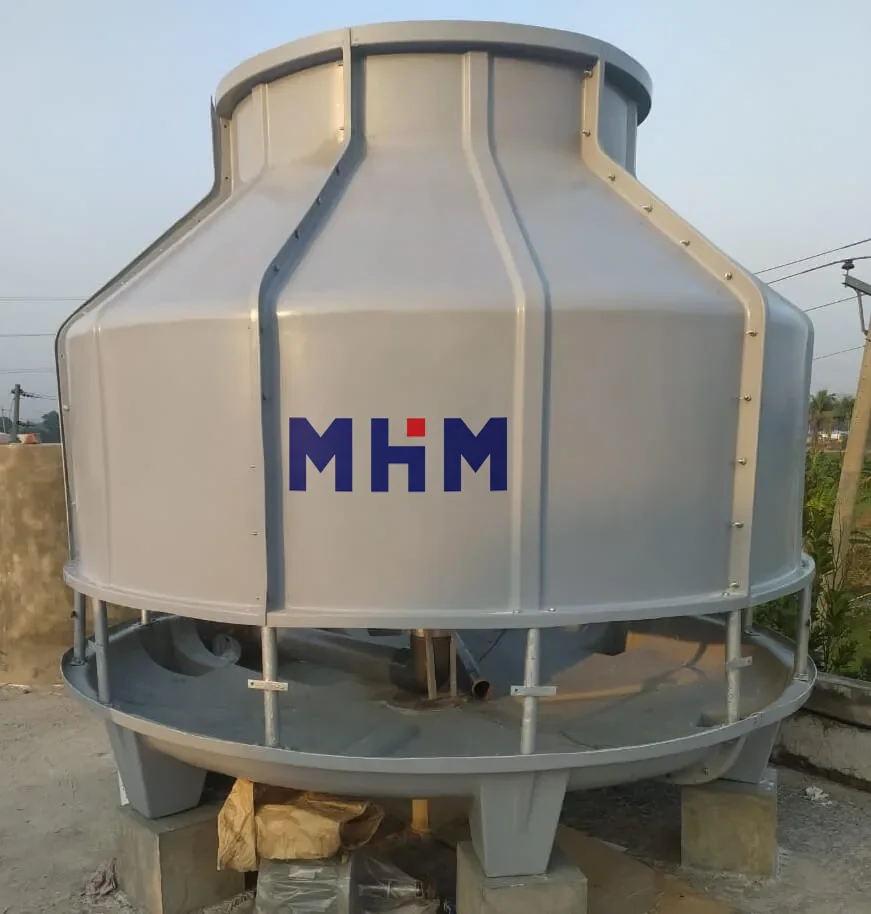
The round FRP tower most factories in Bangladesh already own. Air is drawn straight up against the falling water, so the footprint is small for the duty. This is the range in the capacity table below, 10 TR to 500 TR.
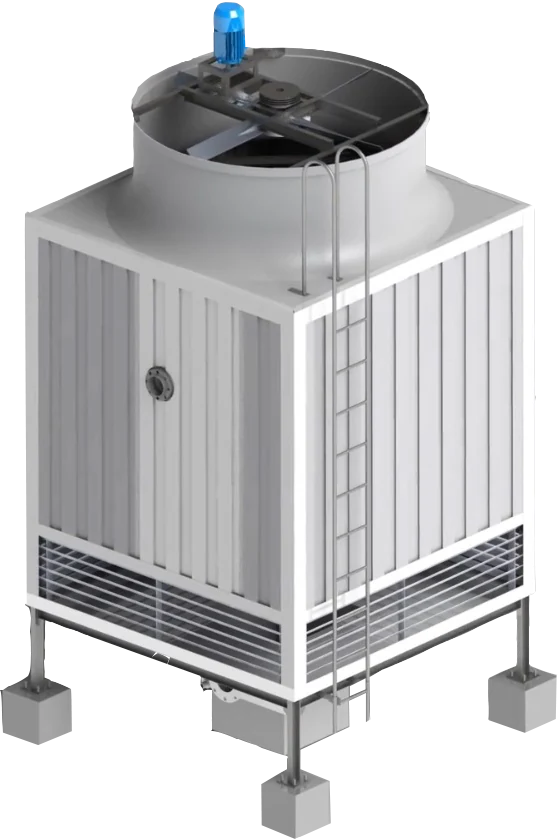
Counter flow square type
The same thermal arrangement packed into a rectangular plan, which suits a roof or a plant yard where a circle wastes space. It is also the shape that bolts together in cells as the duty grows.
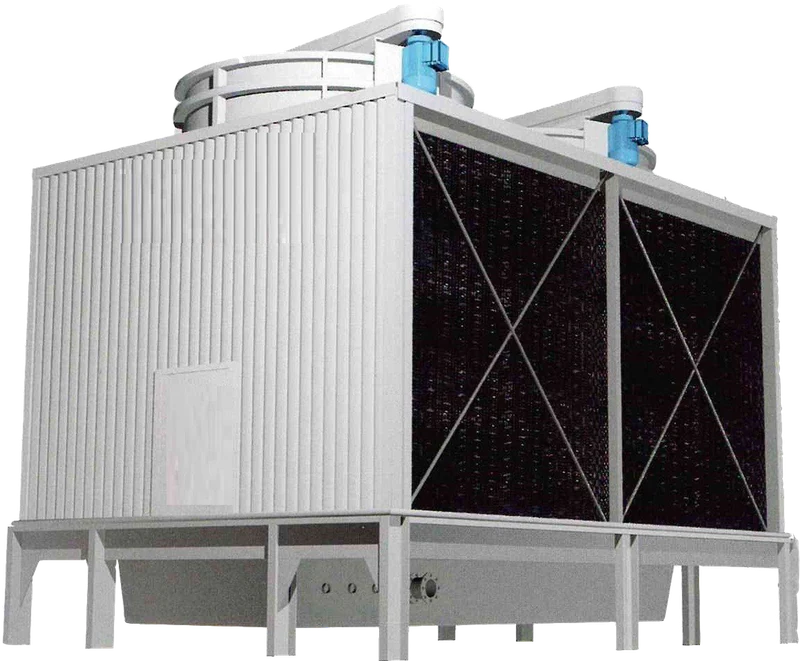
Cross flow rectangular type
Air moves horizontally through the falling water, so the fan works against less static pressure and the hot water basin sits on top, open, where a team can see and clean the distribution without dismantling anything.
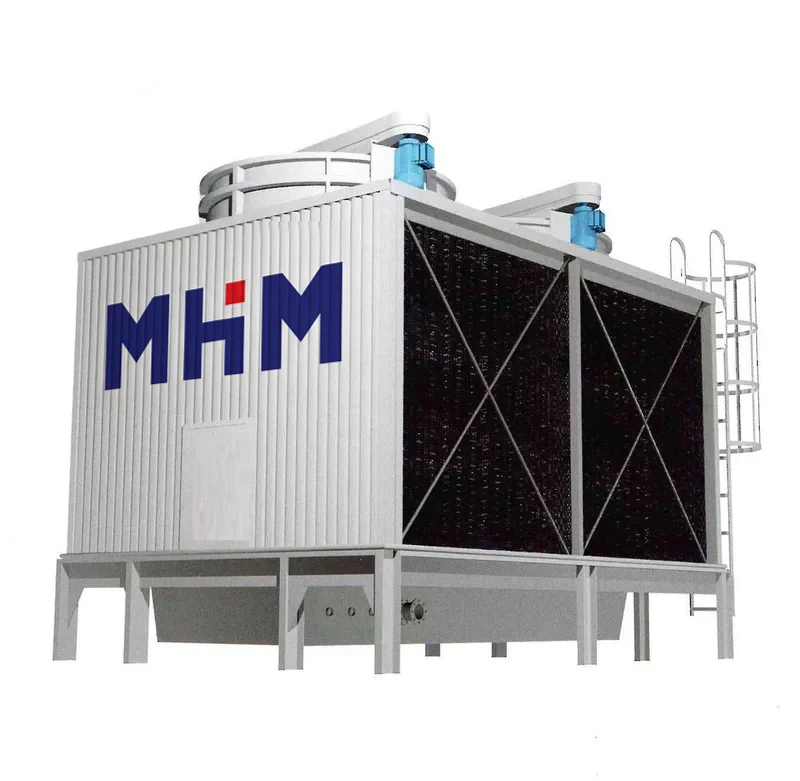
Cross flow splash type
Splash bars instead of close-packed film fill, so water carrying suspended solids or fibre does not blind the fill. The arrangement to specify where the circuit runs dirty, as it does downstream of many dye houses and re-rolling mills.
The short rule: film fill for clean water and a compact footprint, splash fill for dirty water; counter flow for the smallest plan area, cross flow for the easiest maintenance access.
Range, approach and wet-bulb — what a tower is really selected on
Range is the hot water temperature in minus the cold water temperature out. Range is set by your process and the water flow, not by the tower.
Approach is the cold water out minus the ambient wet-bulb temperature, and this is what you are actually buying: a tower cannot make water colder than the wet-bulb, no matter how large the fan. The smaller the approach you specify, the physically larger the tower.
This is why a tower that met its specification on a cool, dry morning falls short on a humid afternoon. Nothing has failed — the wet-bulb has risen and the approach has moved with it. Two practical consequences: the design wet-bulb used for selection has to come from a recognised climatic design data set rather than an assumption, and if a chilled-water plant only loses capacity in the monsoon, look at the wet-bulb and the tower before suspecting the chiller.
Three more numbers decide real performance on site:
- Water distribution — every sprinkler head and nozzle passing its share of the flow
- Air flow — the fan at the correct speed, pitch and direction of rotation
- Free air entry — no wall or neighbouring structure recirculating the hot plume back into the intake
Get those three right, at the wet-bulb the tower was selected for, and a standard tower holds its design temperature. Get any of them wrong and no amount of extra capacity will fix it.
MHM cooling tower specifications — 10 TR to 500 TR
MHM’s counter flow bottle type range, from its own published data sheet. Capacity is nominal TR at the maker’s standard design condition; confirm the range, approach and design wet-bulb behind your selection in writing.
Swipe the table sideways to see every column.
| Capacity (TR) | Water flow (m³/h) | Fan motor (kW) | Tower dia (mm) | Tower height (mm) | Fan dia (mm) | Air flow (m³/h) | Net weight (kg) | Operating weight (kg) | Head loss (kPa) |
|---|---|---|---|---|---|---|---|---|---|
| 10 | 7 | 0.18 | 914 | 1,670 | 440 | 5,700 | 75 | 200 | 20 |
| 20 | 15 | 0.37 | 1,250 | 1,780 | 760 | 9,100 | 110 | 265 | 20 |
| 30 | 21 | 0.75 | 1,300 | 1,780 | 787 | 11,300 | 140 | 300 | 20 |
| 40 | 28 | 1.5 | 1,524 | 1,980 | 787 | on quotation | 165 | 369 | 20 |
| 50 | 35 | 1.5 | 1,740 | 2,010 | 884 | on quotation | 165 | 369 | 25 |
| 60 | 42 | 1.5 | 1,828 | 2,010 | 900 | on quotation | 191 | 433 | 25 |
| 80 | 56 | 1.5 | 2,083 | 2,400 | 1,168 | on quotation | 368 | 730 | 25 |
| 100 | 70 | 2.2 | 2,410 | 2,660 | 1,470 | 50,000 | 607 | 1,023 | 30 |
| 125 | 85 | 2.2 | 2,721 | 2,138 | 1,470 | 43,200 | 695 | 1,130 | 30 |
| 150 | 105 | 2.2 | 3,270 | 2,135 | 1,780 | 56,400 | 780 | 1,860 | 30 |
| 175 | 123 | 4 | 3,220 | 2,585 | 1,780 | 68,400 | 780 | 1,860 | 30 |
| 200 | 140 | 4 | 3,312 | 2,383 | 1,780 | 74,400 | 787 | 2,280 | 30 |
| 250 | 175 | 5.5 | 3,712 | 3,195 | 2,336 | 103,800 | 1,475 | 3,180 | 30 |
| 300 | 210 | 7.5 | 4,435 | 3,624 | 2,336 | 114,000 | 1,750 | 3,460 | 30 |
| 350 | 245 | 7.5 | 4,650 | 3,780 | 2,336 | 130,800 | 1,865 | 3,870 | 40 |
| 400 | 280 | 11 | 4,810 | 4,150 | 2,908 | 154,200 | 1,865 | 3,870 | 40 |
| 500 | 350 | 11 | 5,520 | 4,050 | 2,908 | 176,400 | 2,550 | 7,125 | 40 |
Source: MHM Machineries BD Limited, Counter Flow Bottle Type Cooling Tower specification (PDF). Two columns on that sheet need reading with care. The air-flow column repeats itself — 40 TR and 60 TR both show 23,000 m³/h, 50 TR and 80 TR both show 45,000 — which cannot be right across four different fan diameters, and 45,000 m³/h through the 80 TR tower’s 1,168 mm fan would be about 11.7 m/s against 5.6–7.4 m/s on the rows that do reconcile. Those four cells are therefore shown as “on quotation” rather than reproduced; the 125 TR figure is also printed lower than the 100 TR one. The weight columns repeat in the same way (40 and 50 TR, 150 and 175 TR, 350 and 400 TR are identical), so confirm the operating weight for your exact model in writing before your structural engineer designs the base — operating weight, not net weight, is the figure that matters there. Specifications are subject to change according to requirement, brand and availability.
Connection sizes by capacity
Pipe connection sizes in millimetres, from the same data sheet.
Swipe the table sideways to see every column.
| Capacity (TR) | Inlet | Outlet | Overflow | Drain | Float valve | Make-up |
|---|---|---|---|---|---|---|
| 10 | 40 | 40 | 19 | 19 | 12 | 19 |
| 20 | 40 | 40 | 19 | 19 | 12 | 19 |
| 30 | 76 | 76 | 19 | 19 | 19 | 19 |
| 40 | 76 | 76 | 19 | 19 | 19 | 19 |
| 50 | 76 | 76 | 19 | 19 | 19 | 19 |
| 60 | 76 | 76 | 19 | 19 | 19 | 19 |
| 80 | 100 | 100 | 19 | 19 | 19 | 19 |
| 100 | 100 | 100 | 25 | 25 | 19 | 19 |
| 125 | 125 | 125 | 25 | 25 | 19 | 19 |
| 150 | 150 | 150 | 25 | 25 | 25 | 19 |
| 175 | 150 | 150 | 25 | 25 | 25 | 19 |
| 200 | 150 | 150 | 25 | 25 | 25 | 19 |
| 250 | 200 | 200 | 40 | 40 | 40 | 40 |
| 300 | 200 | 200 | 40 | 40 | 40 | 40 |
| 350 | 200 | 200 | 50 | 50 | 40 | 50 |
| 400 | 200 | 200 | 50 | 50 | 40 | 50 |
| 500 | 250 | 250 | 50 | 50 | 40 | 50 |
Use these to check the pipework and the float-valve arrangement before the tower lands on site.
Sizing a tower against the chiller it serves
The trap here is arithmetic, not equipment: a chiller TR and a tower TR are not the same unit, so the safe route is to work in kW of heat rejection and then ask what condition the tower’s TR column is rated at.
- Add up the heat you have to reject, in kW. Not in TR — in kW. For a water cooled chiller it is the cooling capacity plus the compressor input, and MHM’s chiller sheet publishes both columns: an MCH-60 is 211.0 kW of cooling plus 45 kW of compressor = 256 kW to reject. (That is about 1.2 times the chiller’s TR expressed in kW, which is the usual rule of thumb when a data sheet does not give you the two columns.)
- Know what a tower TR means before you use it. A chiller TR is 3.517 kW of cooling. A tower TR is a nominal rating: at this table’s own flow of about 0.7 m³/h per TR and a 5 °C range, one tower TR carries roughly 4.1 kW — the compressor heat is already inside it. The two numbers are not the same unit, so never convert one into the other with 3.517.
- Divide, then take the next row up. 256 kW ÷ 4.1 kW per tower TR ≈ 62 tower TR, so the 80 TR row is the selection — 56 m³/h of condenser water and 25 kPa of head loss at the tower.
- Confirm the rating basis in writing. The sheet does not state the range, the approach or the design wet-bulb behind its TR column, and those three decide whether 80 TR is generous or marginal on your site. Ask for them on the quotation; we will put them there.
- Then size the pump and check the approach. Condenser pump duty comes from the water flow column and the head loss column plus pipe and condenser losses. Check the approach you need against the design wet-bulb for your site, taken from a recognised climatic design data set rather than an assumption, and take one size up if it is not achievable.
Worked example — a 100 TR water cooled chiller
An MCH-100 is 351.7 kW of cooling with an 80 kW compressor, so it rejects 431.7 kW. At roughly 4.1 kW per tower TR that is about 105 tower TR — so the 125 TR row is the selection, with 85 m³/h of condenser water and 30 kPa of head loss at the tower.
Notice what this does not say: it does not tell you to multiply 100 TR by 1.2 and read the table, because the table’s TR already carries the compressor heat. Doing both oversizes the tower by about a quarter.
For the machine on the other side of this loop see the industrial chiller range, and for type-specific pricing, water cooled chiller price in Bangladesh. In Bengali: কুলিং টাওয়ার কি এবং এর প্রকারভেদ.
What sets the price of a cooling tower in Bangladesh
| Cost driver | Why it changes the price | Effect |
|---|---|---|
| Capacity (TR) | Shell, fill volume, fan and motor scale together. | Largest single driver |
| Tower type | Counter-flow bottle, counter-flow square, cross-flow rectangular or cross-flow splash. | A splash-fill tower is physically larger for the same duty |
| Fill type and material | PVC film fill or splash bars; flute size decides how much fouling it tolerates. | Moderate on capital cost, decisive on maintenance cost |
| Shell and hardware | FRP thickness and resin; galvanised or stainless steel fixings. | Stainless carries a premium and is the right answer near an ETP or dye house |
| Fan and motor | Fan diameter, motor kW, drive arrangement, aluminium or FRP blades. | Also sets the running cost for the life of the tower |
| Approach specified | A tighter approach to the wet-bulb needs a physically larger tower. | Can move the selection by two sizes |
| Origin and lead time | The bottle-type range is imported from China, Malaysia and Thailand; ready stock against indent. | Moves with the exchange rate and duty |
| Installation scope | Basin foundation, condenser piping, valves, pump, electrical work, starter, commissioning. | Quoted as separate lines — always ask for the split |
| Water treatment | Initial dosing programme, softener or filtration if the make-up water is hard. | A small line with a large effect on tower life |
MHM quotes per duty rather than publishing a list price, because the range is imported and freight, LC and duty on the day are inside the number. Spare parts are different: infill, sprinkler heads, nozzles, fans, motors, louvers and distribution pipe carry per-piece prices on their own product pages.
Manufacturer, importer or both? The honest answer
Buyers searching for a “cooling tower manufacturer in Bangladesh” deserve a straight answer, because it decides lead time, spares and who is responsible when something fails.
MHM’s published data sheet states the origin of the counter flow bottle type range as China, Malaysia and Thailand, with ready stock held on common sizes. MHM supplies towers under its own brand as well as other reputed brands, and the work done here in Bangladesh is what usually matters on site: selection against your duty, assembly, the basin and foundation arrangement, piping and pump sizing, commissioning, and then cleaning, fill replacement and repair for the life of the tower — including towers MHM did not supply.
So: imported hardware, local engineering, local spares and local service. If a supplier claims every part is made in Bangladesh, ask which parts, and ask where the fill and the fan came from.
Cooling tower parts, and what actually goes wrong
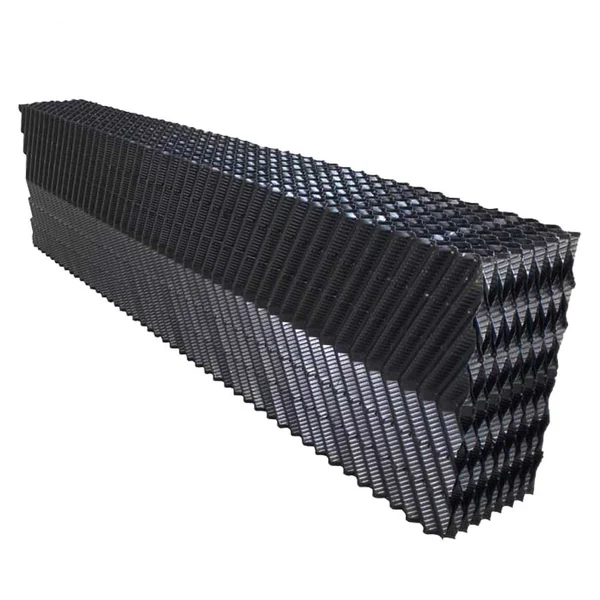
Cooling tower infill (fill media)
The part replaced most often, because fill blinds with scale, silt and biological growth and stops transferring heat long before it looks bad. Box, round and cross-flow leaf infill in stock sizes, priced per piece on the product pages.
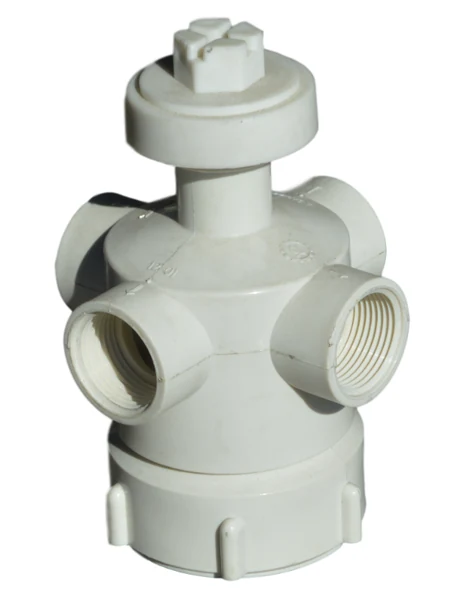
Sprinkler head and spray nozzles
Clogged heads and nozzles put water down unevenly, so half the fill runs dry while the other half floods. Check these first when a tower stops hitting its design temperature.
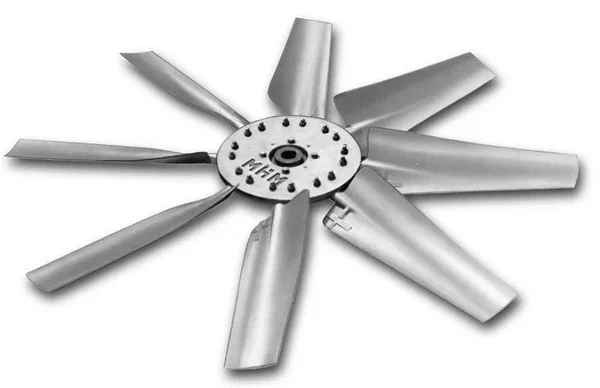
Fan and fan motor
Aluminium and FRP fan assemblies and wet-duty motors. A replacement motor wired for the wrong direction of rotation blows air the wrong way through the fill — flow drops to roughly a third to a half of design and water spills out through the louvers, which is the giveaway. Rotation is checked at commissioning for exactly this reason.
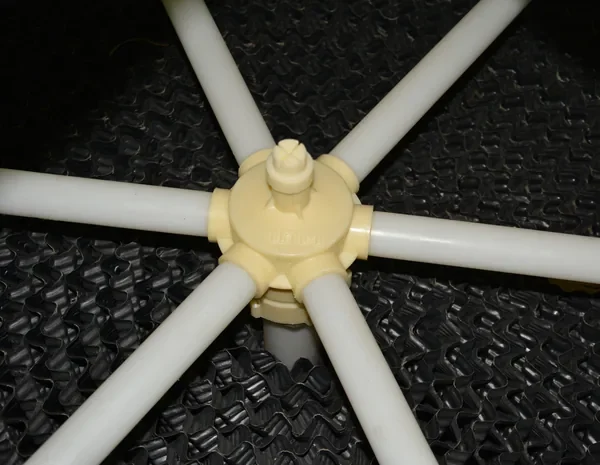
Water distribution pipe
Rotating arms and distribution pipework for round towers. Cracked pipes and worn bearings show up as a wet patch on one side of the fill and a warm return line.

Air inlet louver
PVC louvers keep sunlight out of the basin (sunlight feeds algae) and keep water in. Broken louvers are a common cause of algae growth and drift complaints.
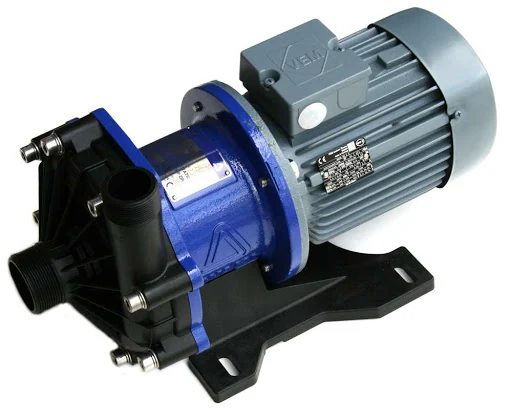
Chemicals, pumps and softener
Scale, corrosion and biological control chemicals for the tower circuit, condenser-water pumps sized against the flow and head loss columns, and a softener plant where the make-up water is hard.
Almost every “the tower is not cooling” complaint traces back to one of the items above. Background reading: কুলিং টাওয়ার কতবার পরিষ্কার করা উচিত and কুলিং টাওয়ারে কি কেমিক্যাল ব্যবহার করা হয়.
Where cooling towers work in Bangladeshi plants
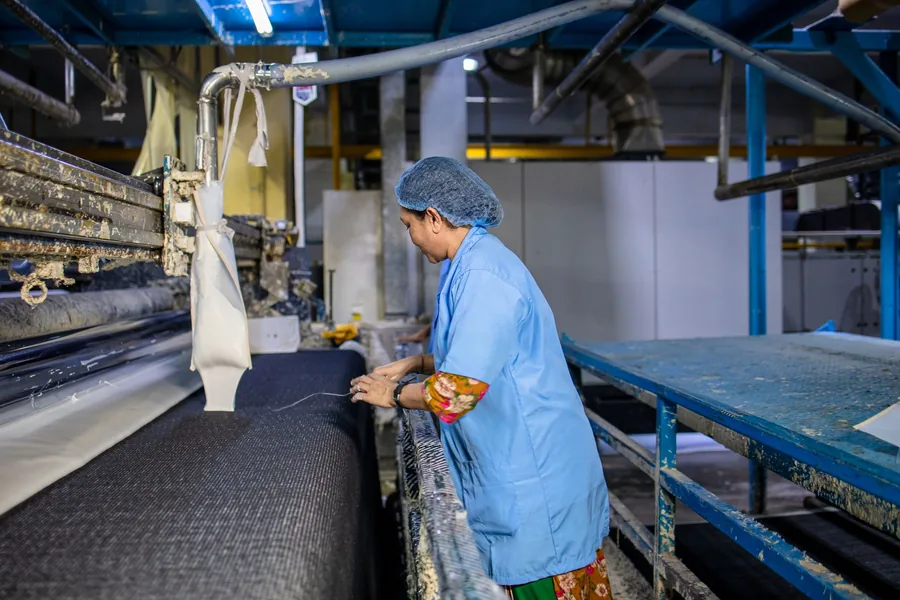
Textile dyeing and finishing
Two duties on one site: the tower carries condenser heat from the water cooled chillers serving the dyeing machines, and it also cools air compressors, machine bearings and in many mills a direct process circuit. Make-up water is often hard and the air carries lint, so fill blinding and scale are the two failure modes to design against.
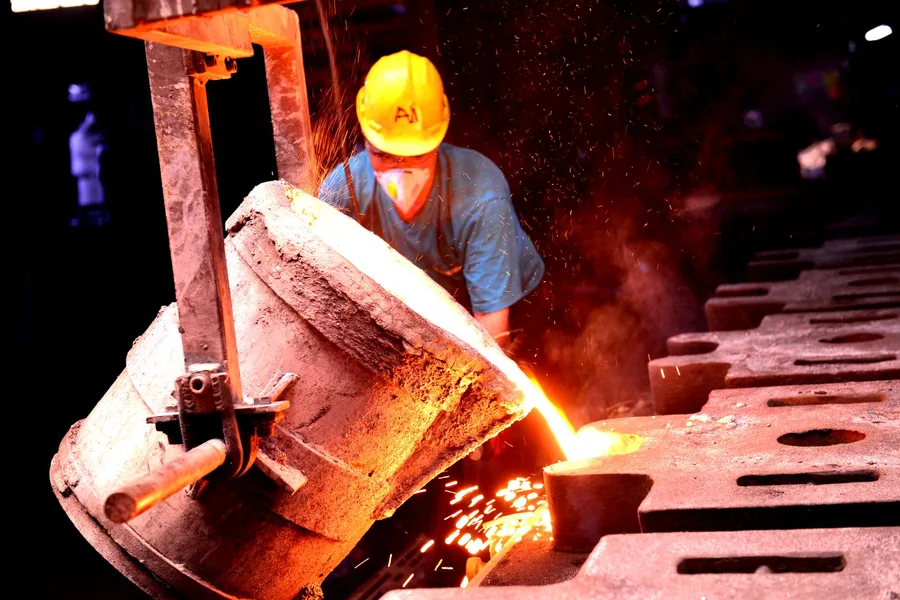
Steel re-rolling and induction furnaces
The furnace coil runs on a closed circuit of clean, low-conductivity water that must never see raw tower water; the heat crosses into the open tower circuit through a plate or shell-and-tube heat exchanger. Losing tower performance stops the furnace, so these plants are built with a standby cell, a standby pump and a temperature alarm.
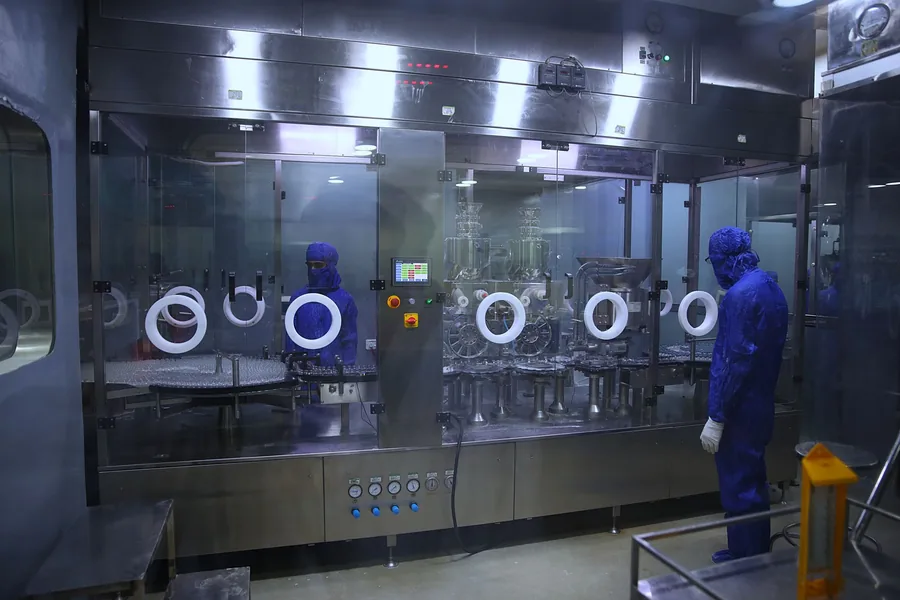
Plastics, food and pharma
Tower water cools hydraulic oil, mould circuits that do not need chilled water, and the condensers of the plant’s chillers. In pharma and food plants the tower is usually specified in cells so one can be cleaned while the plant keeps running, and drift control is treated as a hygiene item because a tower plume is an aerosol.
Installation, commissioning and maintenance
Installation
Basin foundation and levelling, tower assembly, condenser-water piping with strainers and valves, make-up and overflow connections with the float valve set, the electrical connection and starter, and the interlock that stops the pump and the tower fan running out of sequence. Free air entry on every face and clearance from walls and neighbouring structures are set at this stage; getting them wrong causes recirculation that no amount of later maintenance will fix.
Commissioning
Flush and clean the basin before the circuit is opened to the plant, verify water flow against the table above, check that every sprinkler arm and nozzle passes water evenly, confirm fan rotation, current draw and vibration, and take a temperature check across the tower under real load so the range and approach are recorded on day one. Those first readings are the baseline every later complaint is measured against.
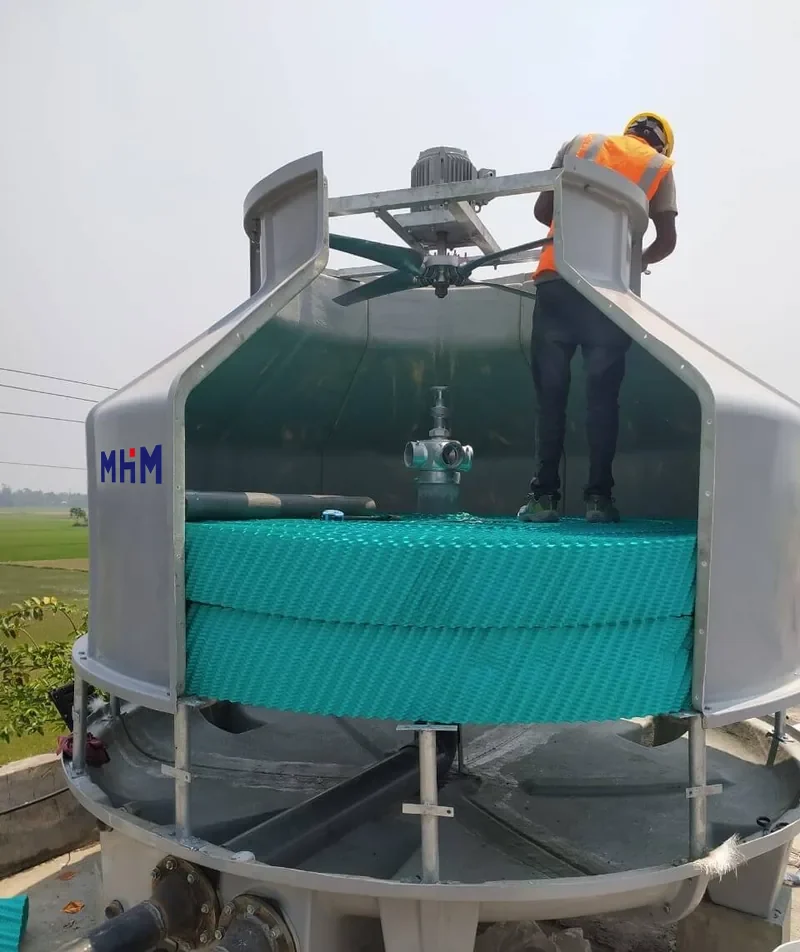
Maintenance
Scheduled cleaning, fill and nozzle replacement, fan and motor service, and a dosing and blowdown programme matched to your make-up water. Make-up water replaces three losses — evaporation, which is the loss that does the cooling; drift, which is water carried out as droplets and is minimised by the drift eliminator; and blowdown, which is water deliberately dumped so dissolved solids cannot concentrate. Raising cycles of concentration cuts water use but raises the scaling risk, which is why the treatment programme is part of the tower scope and not an optional extra. MHM service and maintenance.
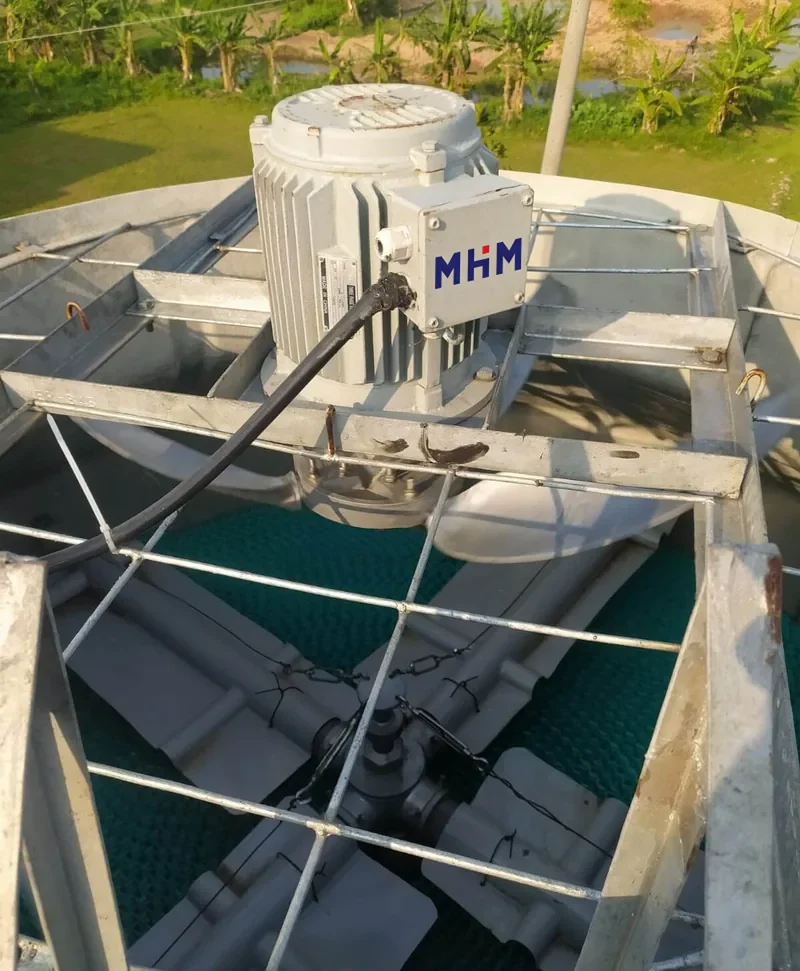
Why buyers choose MHM Machineries
MHM Machineries BD Limited has supplied cooling towers and their spares from Mirpur, Dhaka since 2019, and maintains them for textile, steel and general manufacturing plants across the country.
- Four tower arrangements from one supplier; the bottle-type range is published 10 TR to 500 TR
- Published specifications — capacity, fan motor, connection sizes and operating weights are public PDFs
- Every wear part in stock sizes: infill, sprinkler, nozzle, fan, motor, louver, distribution pipe
- Condenser pumps, piping, insulation and water treatment chemicals in the same scope
- Cleaning, fill replacement and repair service on any tower, including units MHM did not supply
- Chillers, heat exchangers and HVAC on the same plant, so the whole loop is looked at together
- Written quotation with equipment and installation as separate lines
সংক্ষেপে — বাংলায়
Cooling tower সঞ্চালিত পানির সামান্য অংশ evaporate করে তাপ বাতাসে ছেড়ে দেয় এবং ঠান্ডা পানি আবার plant-এ ফিরিয়ে দেয়। MHM Machineries BD Ltd ১০ TR থেকে ৫০০ TR পর্যন্ত FRP counter flow ও cross flow tower, সব ধরনের spare parts, installation ও service দেয়।
Tower নির্বাচনের আসল দুটি হিসাব — range (গরম পানি ঢোকা বিয়োগ ঠান্ডা পানি বের হওয়া) এবং approach (ঠান্ডা পানি বিয়োগ বাতাসের wet-bulb তাপমাত্রা)। Wet-bulb-এর নিচে কোনো tower পানি ঠান্ডা করতে পারে না, তাই আর্দ্র দিনে tower দুর্বল মনে হয় — এটা tower-এর দোষ নয়।
সবচেয়ে বড় হিসাবের ভুলটা এখানে: chiller-এর TR আর tower-এর TR এক একক নয়। Chiller-এর ১ TR = ৩.৫১৭ kW ঠান্ডা করার ক্ষমতা; কিন্তু tower-এর TR একটা nominal মাপ — এই table-এর নিজের প্রবাহ (প্রতি TR-এ প্রায় ০.৭ m³/h) আর ৫ °C range ধরলে প্রতি tower TR প্রায় ৪.১ kW তাপ সরায়, যার ভেতরে compressor-এর তাপও ধরা আছে। তাই kW-তে হিসাব করতে হয়: MCH-৬০-এর ক্ষেত্রে ২১১ + ৪৫ = ২৫৬ kW ÷ ৪.১ ≈ ৬২ tower TR, অর্থাৎ ৮০ TR row। TR-কে ১.২ গুণ করে আবার table দেখলে tower প্রায় এক-চতুর্থাংশ বড় হয়ে যায়।
Tower ঠান্ডা না করলে প্রথমে দেখতে হয় — infill জমে গেছে কি না, sprinkler ও nozzle বন্ধ কি না, fan-এর ঘোরার দিক ঠিক আছে কি না, আর চারপাশে দেয়াল থাকায় গরম বাতাস আবার ভেতরে ঢুকছে কি না। ফোন +880 1767-004433।
Frequently asked questions
How much does a cooling tower cost in Bangladesh?
Cooling tower price in Bangladesh is set by capacity in TR, the tower type, the fill and casing materials, the fan and motor rating, the origin of the imported components and how much of the installation is in the scope. A 10 TR bottle type tower and a 500 TR unit are different classes of equipment, and the pump, piping and basin foundation are separate lines. Send the heat rejection duty in TR or kW and MHM returns a written quotation against a model from the capacity table. Spare parts — infill, nozzles, fans, motors — carry per-piece prices on their product pages.
What size cooling tower do I need for a 100 TR chiller?
Size the tower against heat rejection, not cooling capacity. A water cooled chiller rejects its evaporator load plus the compressor input, roughly 1.2 to 1.3 times the chiller TR, so a 100 TR chiller typically needs a tower selected for about 120 to 130 TR. Condenser water flow is about 0.7 m³/h per tower TR — the same as 3 US gallons per minute per ton — so the pump has to move roughly 85 to 91 m³/h. Always take the heat rejection figure from the chiller data sheet where it states one.
What is the difference between a counter flow and a cross flow cooling tower?
In a counter flow tower the air travels straight up against the falling water, which gives a compact footprint and good thermal performance per square metre; this is the arrangement used in the round bottle type and square FRP towers. In a cross flow tower the air passes horizontally through the falling water, which lowers the fan static pressure and puts the hot water basin on top where it is easy to inspect and clean. Cross flow is often chosen where the water is dirty or headroom is limited.
What are range and approach in a cooling tower?
Range is the difference between the hot water entering the tower and the cold water leaving it, and it is set by your process, not by the tower. Approach is the difference between the cold water leaving the tower and the ambient wet-bulb temperature, and it is what the tower is actually selected on. A smaller approach needs a physically larger tower, and no tower can produce water colder than the wet-bulb — which is why a tower that met its specification in winter can fall short on a humid Dhaka afternoon.
What cooling tower capacity range does MHM supply?
MHM supplies counter flow bottle type and square type towers and cross flow rectangular and splash type towers. Published capacity data exists for the FRP bottle type range only: it runs from 10 TR (7 m³/h, 0.18 kW fan motor, 914 mm diameter) up to 500 TR (350 m³/h, 11 kW fan motor, 5,520 mm diameter), and the sheet’s header states the range as 10 TR to 600 TR, so confirm anything above 500 TR on the quotation. For the square and cross flow arrangements the capacity, shell material and fan data come with the quotation rather than from a published table. Ready stock is held on common sizes, and accessories, spares and service are available for all of them.
How much make-up water does a cooling tower need?
Make-up water replaces three losses: evaporation, which is the loss that actually does the cooling and rises with the range; drift, which is water carried out as droplets and is minimised by a drift eliminator; and blowdown, which is water deliberately dumped to stop dissolved solids concentrating. Blowdown is set by the cycles of concentration your water chemistry allows. Raising cycles cuts water use but raises the scaling risk, which is why a treatment programme is part of the tower scope.
Why is my cooling tower not cooling to the design temperature?
In the order these are usually found: blocked or collapsed infill; clogged sprinkler heads or nozzles giving uneven water distribution; a fan running at the wrong speed or in the wrong direction after a motor change; air recirculation because the tower is boxed in by walls or a neighbouring structure; water flow above or below the design figure; and a wet-bulb temperature higher than the one the tower was selected for. Check water distribution first, because it is the cheapest to correct.
Is MHM a cooling tower manufacturer or an importer?
Both apply to different parts of the job. MHM’s own data sheet states the origin of the counter flow bottle type range as China, Malaysia and Thailand, and MHM supplies towers under its own brand as well as other reputed brands. Selection, assembly, basin and foundation arrangement, piping and pump sizing, commissioning, spares and service are done here in Bangladesh, including on towers MHM did not supply.
Who supplies cooling towers in Bangladesh?
MHM Machineries BD Limited supplies, installs, commissions and services FRP cooling towers from 10 TR to 500 TR in counter flow and cross flow configurations, together with infill, sprinkler heads, spray nozzles, fans, motors, distribution pipes, air inlet louvers, condenser water pumps, piping and water treatment chemicals, from 846, East Shewrapara, Mirpur, Dhaka-1216, Bangladesh. Call +880 1767-004433 or e-mail sales@mhmmachineries.com.
Related pages on this site
Get a written quotation
Send the duty and the site, and MHM Machineries BD Ltd replies with a model, the capacity, and equipment and installation priced as separate lines — so two quotations can actually be compared.
- Model and capacity stated against your duty, not a generic list price
- Equipment, accessories and installation as separate lines
- Delivery and lead time confirmed in writing
- Spares and service available from Mirpur, Dhaka
- MHM Machineries BD Limited
846, East Shewrapara, Mirpur, Dhaka-1216, Bangladesh
Open in Google Maps - +880 1767-004433 · +880 1300-806868
WhatsApp +880 1767-004433 - sales@mhmmachineries.com
Tell us the duty
Fill this in and send it straight to our sales desk on WhatsApp or by e-mail. Nothing is stored on this page.