

The State of Industrial Cooling in Bangladesh 2026
Bangladesh’s industrial cooling load in 2026 is set by three published facts. The textile base that carries it — 1,883 BTMA member mills, and US$38,701.15 million of ready-made garment exports in FY2025-26 — treats process cooling as a production input, not an amenity. The grid it draws on served a maximum demand of 17,201 MW on 20 May 2026 against 32,688 MW of installed capacity, of which 2,800 MW is factory captive generation. And R22, the refrigerant a great many Bangladeshi chillers were sold on, is under a Montreal Protocol cut of 67.5 per cent from 2025 and a complete phase-out from 2030. This report works through what those three facts do to a Bangladeshi factory’s chiller decision, using MHM Machineries’ own published specification tables for every equipment number.
Published 4 October 2026 · MHM Machineries BD Ltd, Mirpur, Dhaka · Figures are reproduced with their sources; nothing on this page is estimated.
Key figures for 2026
Every number below is quoted from a named published source. Each one is repeated with its full citation in Method and sources.
- 32,688 MW
- Total installed generation capacity in Bangladesh as on 31 August 2026, including captive power and off-grid plant. The grid-connected part alone is 29,143 MW. Source: Bangladesh Power Development Board.
- 2,800 MW
- Captive power capacity — generation owned and run by industry itself, 8.6 per cent of the national total. Source: BPDB, 31 August 2026.
- 17,201 MW on 20 May 2026
- Maximum demand served. The national peak falls in the pre-monsoon heat, the same weeks in which a factory’s own process-cooling load is highest. Source: BPDB.
- 1,883 mills
- BTMA member mills: 530 yarn manufacturing, 1,008 fabric manufacturing, 345 dyeing-printing-finishing. The 345 wet-processing mills are the heaviest chilled-water users in the sector. Source: Bangladesh Textile Mills Association.
- US$38,701.15 million
- Ready-made garment exports, FY2025-26 — 80.62 per cent of Bangladesh’s US$48,001.91 million total export. Source: BGMEA export performance statement.
- 0.85 to 1.50 kW per TR
- The full published spread of total power input per ton of refrigeration across MHM’s 26-model MCH chiller range, 1.5 TR to 200 TR. Source: MHM Machineries chiller specification sheet, analysed in section 3.
- 67.5 per cent cut from 2025, zero from 2030
- The HCFC control schedule that binds Bangladesh as an Article 5 Party, with only a 2.5 per cent annual average allowed for servicing between 2030 and 2040. Source: Montreal Protocol Decision XIX/6.
1. Who actually carries the cooling load
Industrial cooling in Bangladesh is not spread evenly across manufacturing. It is concentrated in wet processing — dyeing, printing and finishing — where chilled water controls dye-bath and finishing temperatures, and in the compressor rooms, injection moulding halls and reactor jackets that sit behind them. The Bangladesh Textile Mills Association publishes the shape of that base directly.
| Published figure | Value |
|---|---|
| Yarn manufacturing member mills | 530 |
| Fabric manufacturing member mills | 1,008 |
| Dyeing, printing and finishing member mills | 345 |
| Total BTMA member mills | 1,883 |
| Investment in the primary textile sector | Around US$32.00 billion |
| Employment in the primary textile sector | Around 3 million, of which 60 per cent female |
| Fabric produced locally for the domestic requirement | 7.5 billion metres |
| RMG export, FY2025-26 | US$38,701.15 million |
| Total national export, FY2025-26 | US$48,001.91 million |
| RMG share of total export | 80.62 per cent |
Mill counts, investment, employment and fabric output as published by BTMA; export values as published by BGMEA. Both fetched 22 September 2026.
The reading that matters is the ratio. There are roughly three fabric mills and one and a half yarn mills for every wet-processing mill, but it is the wet-processing mill that needs chilled water at a controlled temperature all shift. Cooling capacity here is concentrated in a few hundred sites, each buying tens or hundreds of tons of refrigeration at a time — which is why this market is served by capacity tables rather than by list prices.
2. The power system that cooling has to live inside
A chiller is one of the largest single electrical loads a factory owns, so its economics are set by the power system around it. The Bangladesh Power Development Board publishes the national position on a page it dates precisely; the figures below are as on 31 August 2026.
| Category | Capacity (MW) | Share of 32,688 MW |
|---|---|---|
| Grid-connected generation | 29,143 | 89.2 per cent |
| Captive power (industry-owned) | 2,800 | 8.6 per cent |
| Off-grid renewable energy | 738 | 2.3 per cent |
| Off-grid HFO | 7 | Under 0.1 per cent |
| Total installed capacity | 32,688 | 100 per cent |
| Maximum demand served, 20 May 2026 | 17,201 | 52.6 per cent |
Capacities as published by BPDB, as on 31 August 2026. The share column is arithmetic on those published figures, not a separate source.
Two things follow for anyone specifying cooling plant here. First, 2,800 MW of captive generation means a large slice of Bangladeshi industry pays for its own electricity at its own generator’s cost, not at a utility tariff — so an extra kilowatt of connected chiller load is felt directly in fuel. Second, the national maximum demand of 2026 was served on 20 May, in the hottest weeks before the monsoon. That is precisely when condensing temperatures are highest, when a fouled cooling tower costs the most, and when an undersized plant fails. Cooling plant in Bangladesh is specified for the May condition or it is not specified at all.
3. What a chiller draws: MHM’s published range, analysed
There is no published national dataset of industrial chiller efficiency in Bangladesh. What does exist is manufacturers’ own specification data. MHM Machineries publishes a complete 26-model table for its MCH range, 1.5 TR to 200 TR, with a total power input column. Dividing that column by the capacity column gives kilowatts of input per ton of refrigeration — the single number that decides what a chiller costs to run. The analysis below is arithmetic on MHM’s published sheet; nothing is modelled.
| Model | Capacity (TR) | Cooling capacity (kW) | Total power input (kW) | Input per TR (kW/TR) |
|---|---|---|---|---|
| MCH-1.5 | 1.5 | 5.3 | 2 | 1.33 |
| MCH-02 | 2 | 7.0 | 3 | 1.50 |
| MCH-03 | 3 | 10.6 | 4 | 1.33 |
| MCH-04 | 4 | 14.1 | 4 | 1.00 |
| MCH-05 | 5 | 17.6 | 5 | 1.00 |
| MCH-06 | 6 | 21.1 | 7 | 1.17 |
| MCH-7.5 | 7 | 24.6 | 10 | 1.43 |
| MCH-10 | 10 | 35.2 | 12 | 1.20 |
| MCH-12 | 12 | 42.2 | 12 | 1.00 |
| MCH-15 | 15 | 52.8 | 16 | 1.07 |
| MCH-17 | 17 | 59.8 | 18 | 1.06 |
| MCH-20 | 20 | 70.3 | 22 | 1.10 |
| MCH-25 | 25 | 87.9 | 25 | 1.00 |
| MCH-30 | 30 | 105.5 | 28 | 0.93 |
| MCH-35 | 35 | 123.1 | 35 | 1.00 |
| MCH-40 | 40 | 140.7 | 40 | 1.00 |
| MCH-50 | 50 | 175.8 | 48 | 0.96 |
| MCH-60 | 60 | 211.0 | 54 | 0.90 |
| MCH-70 | 70 | 246.2 | 65 | 0.93 |
| MCH-80 | 80 | 281.4 | 74 | 0.93 |
| MCH-100 | 100 | 351.7 | 88 | 0.88 |
| MCH-120 | 120 | 422.0 | 105 | 0.88 |
| MCH-130 | 130 | 457.2 | 114 | 0.88 |
| MCH-150 | 150 | 527.5 | 130 | 0.87 |
| MCH-180 | 180 | 633.1 | 154 | 0.86 |
| MCH-200 | 200 | 703.4 | 170 | 0.85 |
Important caveat. MHM’s sheet states no rating condition for the total power input column, and does not attribute it to an air-cooled or a water-cooled condenser arrangement. The column is therefore usable for comparing models inside this range, and not for comparing brands. The sheet also carries MHM’s own note that specifications are subject to change according to requirement, brand and availability. Confirm the rating condition in writing on any quotation. The input-per-TR column is calculated here from the two published columns beside it.
Three findings a buyer can use
Below 20 TR, the published figure scatters. It runs from 1.00 kW/TR at MCH-04, MCH-05, MCH-12 and MCH-25 up to 1.50 kW/TR at MCH-02 and 1.43 kW/TR at MCH-7.5. The small models are published to the nearest whole kilowatt, which is enough to move the ratio by a third at these sizes. Do not read a 2 TR machine as inherently worse than a 4 TR machine on this basis — read it as a column that is too coarsely rounded to compare small models against each other.
From 20 TR upward the trend is real and steady. Input per TR falls from 1.10 kW/TR at MCH-20 to 0.85 kW/TR at MCH-200 — 23 per cent less electrical input for the same ton of cooling.
Oversizing is paid for twice. Take a plant whose measured duty is 100 TR. MCH-100 is published at 88 kW total input. MCH-150, bought as head-room, is published at 130 kW — 42 kW of additional connected load, or 48 per cent more, for cooling the plant did not need. Over 1,000 running hours at full load that is 88,000 kWh against 130,000 kWh. A lightly loaded chiller does draw less than its rated input, but it also runs further from its best efficiency point, and the larger machine still costs more to buy, to install and to feed from a captive generator sized around it.
How to use these numbers on your own plant. Annual energy = published total power input (kW) × running hours per year × load factor. A plant running 12 hours a day, 26 days a month has 3,744 running hours a year; at MCH-100’s published 88 kW that is 329,472 kWh a year at full load. Multiply by your own tariff or by your captive generator’s cost per kWh — this report does not publish an electricity price, because the rate that applies to your connection depends on your voltage level, your category and your time-of-use band.
The right way to arrive at the duty in the first place is measurement, not a rule of thumb: cooling load in kW = chilled-water flow in litres per second × 4.19 × the temperature drop in °C, and 1 TR = 3.517 kW = 12,000 BTU/h. The worked method is on MHM’s industrial chiller page.
4. What the cooling tower adds to the bill
On a water-cooled plant the cooling tower is often blamed for the electricity bill. MHM’s published bottle-type tower table, 10 TR to 500 TR, lets that be checked instead of assumed. Dividing the published fan motor rating by the published capacity gives the fan’s share per ton of heat rejection.
| Capacity (TR) | Water flow (m³/h) | Fan motor (kW) | Fan kW per tower TR |
|---|---|---|---|
| 10 | 7 | 0.18 | 0.018 |
| 20 | 15 | 0.37 | 0.019 |
| 30 | 21 | 0.75 | 0.025 |
| 40 | 28 | 1.5 | 0.038 |
| 50 | 35 | 1.5 | 0.030 |
| 60 | 42 | 1.5 | 0.025 |
| 80 | 56 | 1.5 | 0.019 |
| 100 | 70 | 2.2 | 0.022 |
| 125 | 85 | 2.2 | 0.018 |
| 150 | 105 | 2.2 | 0.015 |
| 175 | 123 | 4 | 0.023 |
| 200 | 140 | 4 | 0.020 |
| 250 | 175 | 5.5 | 0.022 |
| 300 | 210 | 7.5 | 0.025 |
| 350 | 245 | 7.5 | 0.021 |
| 400 | 280 | 11 | 0.028 |
| 500 | 350 | 11 | 0.022 |
Capacity, water flow and fan motor as published by MHM; the fan-per-TR column is calculated from them. The sheet’s air-flow column is not used in this analysis.
Worked example: a 100 TR water-cooled plant
- Duty. MCH-100 is published at 351.7 kW cooling, 88 kW total input, 1,010 litres per minute of chilled water.
- Heat to reject. Cooling kW plus compressor kW: 351.7 + 80 = 431.7 kW.
- Tower size. At about 4.1 kW of rejection per tower TR, 431.7 ÷ 4.1 ≈ 105 tower TR — so the next published size, the 125 TR tower.
- Condenser water. About 0.7 m³/h per TR, so roughly 74 m³/h; the 125 TR tower is published at 85 m³/h, which covers it.
- Fan power. The 125 TR tower’s published fan motor is 2.2 kW — 2.5 per cent on top of the chiller’s own 88 kW.
Across the whole published range the fan motor is between 0.015 and 0.038 kW per tower TR, and sixteen of the seventeen capacities sit at or below 0.030 kW per TR. The tower fan is not where a water-cooled plant’s electricity goes. The condenser pump is a separate and larger line, and the real penalty of a neglected tower is indirect: fouled infill, blocked nozzles or recirculating hot air raise the condensing temperature, and the chiller compressor — 80 kW of the 88 on this example — works harder for the same cooling. That is why cleaning schedules and fill replacement are an energy measure, not housekeeping. The full tower range, types and sizing method are on MHM’s cooling tower page, and the fans and blowers that move air through plant rooms are on the industrial fan page.
5. The deadline nobody quotes for: R22 ends in 2030
Bangladesh acceded to the Montreal Protocol on 2 August 1990 and ratified the Kigali Amendment on 8 June 2020. It is an Article 5 Party, and the Multilateral Fund had approved US$20,160,736 for Bangladesh as at 31 December 2025. The HCFC control schedule that Article 5 Parties agreed under Decision XIX/6 uses the average of the 2009 and 2010 levels as its baseline and steps down as follows.
| Year | Control step | Allowed, as share of baseline |
|---|---|---|
| 2009–2010 | Baseline: the average of these two years’ consumption and production | Reference |
| 2013 | Freeze at baseline | 100 per cent |
| 2015 | 10 per cent reduction | 90 per cent |
| 2020 | 35 per cent reduction | 65 per cent |
| 2025 | 67.5 per cent reduction | 32.5 per cent |
| 2030 | Complete phase-out | 0 per cent |
| 2030–2040 | Servicing of existing refrigeration and air-conditioning equipment only | 2.5 per cent annual average |
Schedule as adopted in Decision XIX/6 for Parties operating under paragraph 1 of Article 5. Bangladesh is such a Party.
What this means in a Bangladeshi plant room is simple and it is already happening. A chiller bought today has a service life measured in decades; the legal supply of the refrigerant it may be charged with falls to 32.5 per cent of baseline this year and to nothing in 2030, apart from a servicing allowance averaging 2.5 per cent. Whatever a gas cylinder costs today, the direction of that price over a chiller’s life is fixed by treaty.
The buying rule that follows. Ask for the refrigerant in writing on every chiller quotation, and ask what the machine can be retrofitted to. MHM’s own published chiller sheet lists the range as available on R22 or R407c, and specification sheets across this industry commonly still show R22 because they document what has been supplied historically as well as what is offered now. Treat the refrigerant as a line item to be confirmed per order, exactly like the compressor brand and the rating condition — not as something the datasheet has already settled.
Method and sources
This report contains no survey, no estimate and no modelled figure. It has two kinds of number and they are kept apart deliberately.
Published external statistics were fetched from the publishing organisation’s own site on 22 September 2026 and are quoted with the value and the date the publisher states. They are listed below with their exact addresses.
Equipment numbers come from MHM Machineries’ own published specification sheets, which are linked from this page and downloadable in full. Where this report calculates something from them — input per TR, fan kW per tower TR, percentage shares — the calculation is stated in the text or the table note, and the published columns it came from are printed beside it. The cooling tower sheet’s air-flow column and the chiller sheet’s water connection sizes are not used in this analysis.
What is not here. There is no electricity price, because the rate that applies depends on voltage level, consumer category and time-of-use band. There is no average fuel saving, payback period or installed-base figure, because no verified dataset for those exists for Bangladesh and this report will not publish an estimate dressed as a measurement. Conversions used and shown: 1 TR = 3.517 kW = 12,000 BTU/h; cooling kW = litres per second × 4.19 × ΔT in °C; about 0.7 m³/h of condenser water per TR, which is the metric equivalent of 3 US gallons per minute per ton.
| Source | What it supplied | Address |
|---|---|---|
| Bangladesh Power Development Board — Present Installed Generation Capacity, as on 31 August 2026 | 29,143 MW grid; 2,800 MW captive; 738 MW off-grid renewable; 7 MW off-grid HFO; 32,688 MW total; maximum demand served 17,201 MW on 20 May 2026 | bpdb.gov.bd |
| Bangladesh Textile Mills Association | 1,883 member mills; 530 yarn; 1,008 fabric; 345 dyeing-printing-finishing; about US$32.00 billion invested; about 3 million employed, 60 per cent female; 7.5 billion metres of fabric | btmadhaka.com |
| BGMEA — Comparative Statement on Export of RMG and Total Export of Bangladesh | RMG export US$38,701.15 million and total export US$48,001.91 million in FY2025-26; RMG share 80.62 per cent | bgmea.com.bd |
| Ozone Secretariat, UNEP — Decision XIX/6 | The HCFC control schedule for Article 5 Parties: 2009–2010 baseline, 2013 freeze, 2015 −10 per cent, 2020 −35 per cent, 2025 −67.5 per cent, 2030 phase-out, 2.5 per cent servicing average 2030–2040 | ozone.unep.org |
| Ozone Secretariat, UNEP — Bangladesh country profile | Accession 2 August 1990; Kigali Amendment ratified 8 June 2020; Article 5 status; US$20,160,736 approved by the Multilateral Fund as at 31 December 2025 | ozone.unep.org |
| MHM Machineries chiller specification (PDF) | The 26-model MCH table: capacity in TR and BTU/h, cooling kW, chilled-water flow, compressor power, total power input | Download the sheet |
| MHM Machineries bottle-type cooling tower specification (PDF) | The 17-capacity table, 10 TR to 500 TR: water flow, fan motor, tower and fan dimensions, weights, head loss, connection sizes | Download the sheet |
All external pages fetched 22 September 2026. Full URLs, the exact figure taken from each, and the verification step are recorded in the source register held with this report.
Frequently asked questions
How much electricity does an industrial chiller use in Bangladesh?
On MHM’s published MCH range the total power input is between 0.85 and 1.50 kilowatts per ton of refrigeration, and above 20 TR it settles into a steady decline from 1.10 kW/TR at MCH-20 to 0.85 kW/TR at MCH-200. A 100 TR machine is published at 88 kW, so a plant running 12 hours a day for 26 days a month — 3,744 hours a year — draws about 329,472 kWh a year at full load, before the condenser pump. Multiply by your own tariff or captive generation cost. The published column states no rating condition, so confirm it in writing on the quotation.
Does a cooling tower add much to the electricity bill?
Not directly. Across MHM’s published bottle-type range the fan motor is 0.015 to 0.038 kW per tower ton, and sixteen of the seventeen published capacities are at or below 0.030 kW per ton. On a 100 TR water-cooled plant the matched 125 TR tower carries a 2.2 kW fan against the chiller’s 88 kW — about 2.5 per cent. The tower’s real energy effect is indirect: fouled infill, blocked nozzles or recirculating hot air raise the condensing temperature and make the compressor work harder, and the compressor is 80 of those 88 kilowatts.
Is R22 still legal in Bangladesh in 2026?
Bangladesh is a Party operating under paragraph 1 of Article 5 of the Montreal Protocol, so the HCFC schedule adopted in Decision XIX/6 applies to it: a freeze at the 2009–2010 baseline in 2013, a 10 per cent cut in 2015, 35 per cent in 2020, 67.5 per cent in 2025 and complete phase-out in 2030, with only a 2.5 per cent annual average permitted between 2030 and 2040 for servicing equipment already installed. Supply is therefore shrinking to a servicing tail within the service life of any chiller bought now. Ask for the refrigerant in writing and ask what the machine can be retrofitted to.
Why does this report not publish an average fuel saving or payback period?
Because no verified dataset for those numbers exists for Bangladesh, and an estimate presented as a measurement is worse than no number at all. Every figure on this page is either quoted from a named publisher with its date, or calculated in front of the reader from two published columns printed beside it. Fuel-saving measured on a specific plant depends on what was there before, the load profile, the condensing conditions and the control strategy — it belongs in a site report, not in a national average.
How do I size a chiller and its cooling tower for my own plant?
Measure, do not estimate. Cooling load in kilowatts = chilled-water flow in litres per second × 4.19 × the temperature drop in °C; divide by 3.517 for tons of refrigeration. Then size the tower against heat rejection, not cooling: cooling kW plus compressor kW, divided by about 4.1 kW per tower ton. For a 100 TR chiller that is 351.7 + 80 = 431.7 kW, about 105 tower tons, which rounds up to the published 125 TR tower and roughly 74 m³/h of condenser water at 0.7 m³/h per ton. The full worked method is on the chiller page and the cooling tower page.
Put these numbers against your own plant
Send the measured duty — chilled-water flow, supply and return temperature, running hours — and MHM Machineries BD Ltd replies with a model from the published capacity table, the rating condition in writing, and equipment and installation priced as separate lines, so two quotations can actually be compared.
- Model and capacity stated against your duty, not a generic list price
- Refrigerant and rating condition confirmed in writing
- Equipment, accessories and installation as separate lines
- Spares, cleaning and fill replacement available from Mirpur, Dhaka
- MHM Machineries BD Limited
846, East Shewrapara, Mirpur, Dhaka-1216, Bangladesh
Open in Google Maps - +880 1767-004433 · +880 1300-806868
WhatsApp +880 1767-004433 - sales@mhmmachineries.com
Tell us the duty
Fill this in and send it straight to our sales desk on WhatsApp or by e-mail. Nothing is stored on this page.
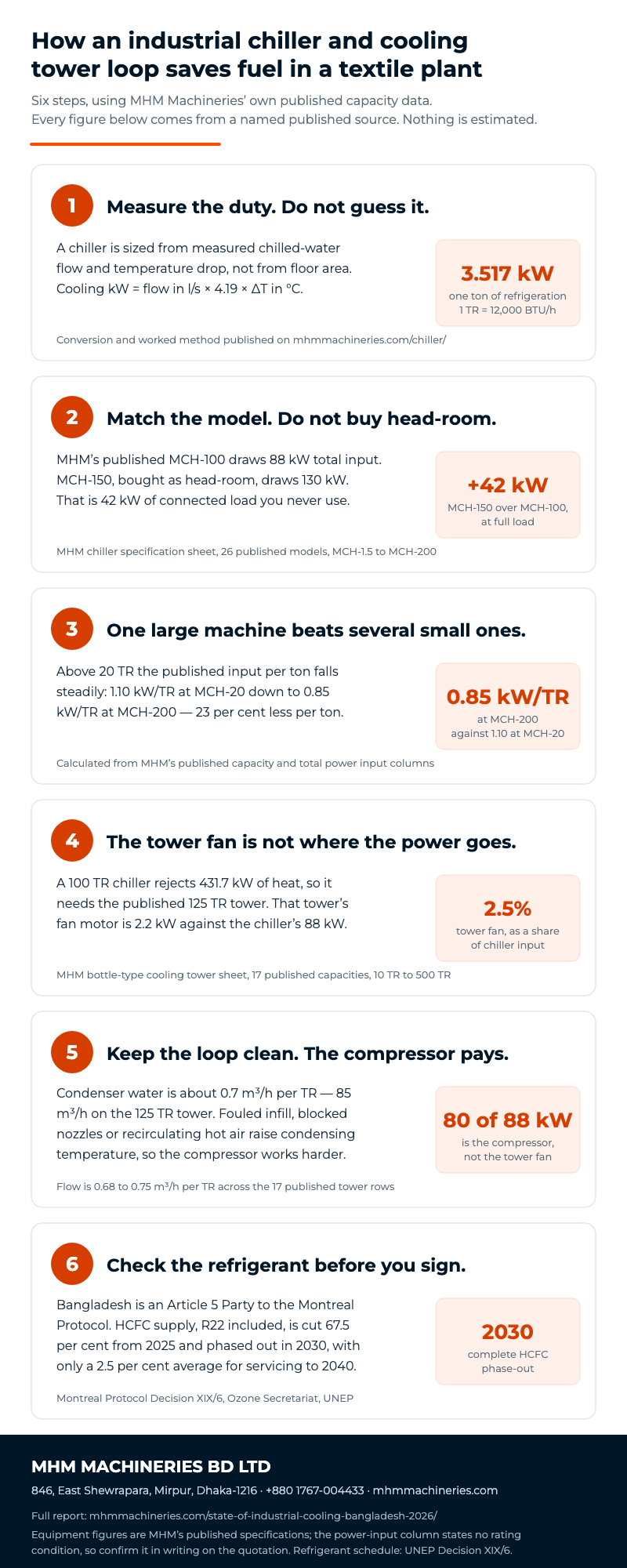
How an industrial chiller and cooling tower loop saves fuel in a textile plant
The six steps below are the working conclusions of this report, on one page. Every figure on it is either MHM Machineries’ own published specification data or the Montreal Protocol HCFC schedule — the same sources set out in Method and sources. It is sized for a factory notice board as well as for a screen.
Use this infographic on your own site
You are welcome to publish this infographic on your own site, blog, newsletter or training material, free of charge, provided the credit link to MHM Machineries stays with it. Copy the code below exactly as it is — it carries the image and the credit together. Click inside the box to select all of it.
Terms, in one line: reproduce the infographic unaltered and keep the credit link to MHM Machineries BD Ltd — industrial chiller supplier in Bangladesh visible next to it. Please do not re-host a cropped version with the source lines removed — those lines are what make the figures checkable. For a print-size file, a Bengali version, or the underlying tables as a spreadsheet, write to sales@mhmmachineries.com.